
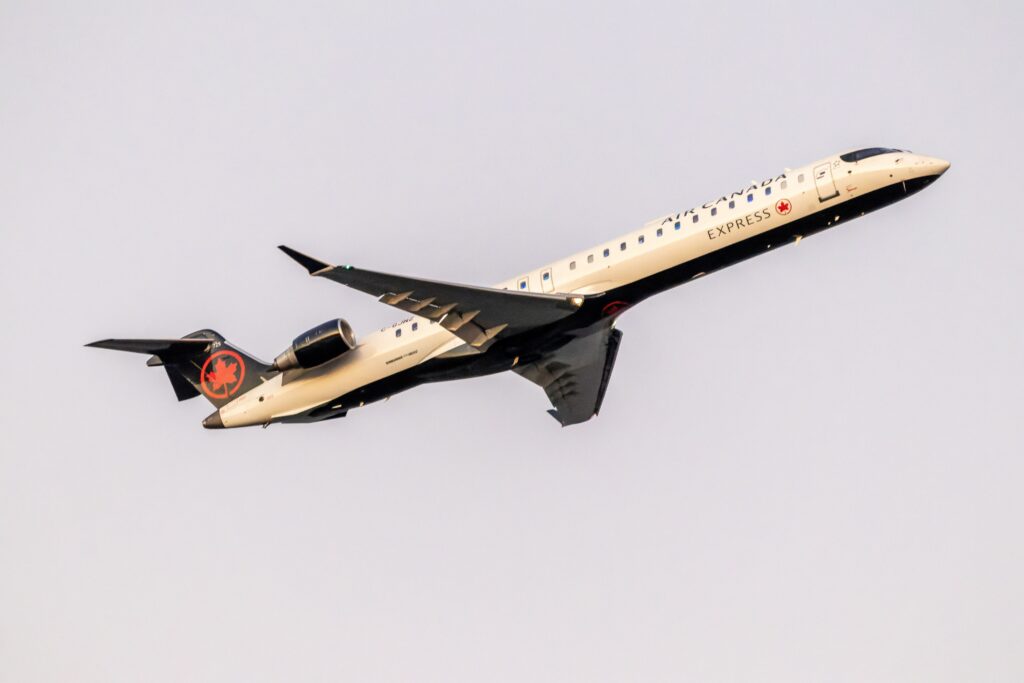

President Donald Trump has targeted Canadian aircraft manufacturer Bombardier in his trade war with Canada. In this photo, an Air Canada Express Bombardier CRJ900 aircraft departs Ronald Reagan Washington National Airport. (Photo by Getty Images/Yassine Bahammou)
WASHINGTON — Canada’s retaliatory tariffs on American goods kicked in Tuesday, escalating a trade war with one of the largest U.S. trading partners that President Donald Trump continued to antagonize over the holiday weekend.
Trump posted an AI-generated cartoon image of himself Sunday evening in which he is depicted as a hockey player striking Canadian Prime Minister Mark Carney, who is shown down on the ice, with a hockey stick.
“Get up, governor,” a speech bubble from Trump’s mouth reads, apparently referring to Canada as a U.S. state rather than a sovereign country.
Nearly $28 billion in U.S. exports crossing the border to Canada now carry up to 50% tariffs, a dollar-for-dollar match on Trump’s taxes on Canadian goods imposed last month, according to Canadian officials.
Among the 629 categories of products Canada has targeted are key outputs from U.S. states with hotly contested races in the fast-approaching November midterm elections, including Maine’s paper and lumber industry, Michigan’s vehicle manufacturing and Wisconsin dairy production.
U.S. Sen. Susan Collins, a Maine Republican who’s in the midst of a tough reelection campaign, warned in late August roughly $170 million of her state’s goods will be impacted by the Canadian tariffs, with more than half of that coming from the forest product sector. Canada revised its tariff proposal Aug. 27 to exclude seafood, including Maine’s significant lobster industry.
5% of goods in question
The United States and Canada’s dueling tariffs represent roughly 5% of the two countries’ massive and intertwined trading partnership, which totaled $879.9 billion in goods in 2025, according to the U.S. Bureau of Economic Analysis.
But the escalation has been accompanied by Trump’s near constant trolling of the U.S. northern neighbor, including threats since his days on the 2024 campaign trail to annex Canada as the 51st state.
Over the Labor Day weekend, the president declared on his Truth Social platform “NO MORE SELLING BOMBARDIER IN THE UNITED STATES!”
“If they want our Market, they must build here, and stop treating America like a ‘piggybank.’ BUY AMERICAN. FLY ON AMERICAN AIRLINERS. ENJOY AMERICAN LIQUOR AND BEVERAGES. SAIL ON LAKE AMERICA. AMERICA FIRST!” Trump wrote, referencing his executive order Aug. 27 renaming Lake Ontario to Lake America.
The Canadian airline maker Bombardier has multiple manufacturing partners and facilities in the United States, including in Arizona, Florida, Indiana, Kansas and New Jersey, according to the company.
“Bombardier aircraft create tens of thousands of U.S. jobs through the company’s growing American footprint as well as within its supply chain made up of approximately 2,800 American companies across 47 states,” according to a Bombadier statement issued Monday.
“The company spends over $2.5 Billion with suppliers each year. This deeply integrated network and incredible growth stem from the company’s heritage in the business jet industry, dating back to the innovations of Learjet in Wichita, Kansas, and the first business jets to enter service,” the statement continued.
U.S. Sen. Jerry Moran said in a post on X Monday evening that he contacted Trump “to make certain the President is aware of the significant contributions of Bombardier to Kansas and the importance of its presence in Wichita to many Kansas workers at Bombardier and in the Bombardier supply chain.”
The company supports roughly 1,000 jobs in the state, according to the Kansas Republican.
Executive orders
Trade talks between the U.S. and Canada collapsed Aug. 21. In days prior Trump had said he would delay new tariffs on Canadian goods while negotiations continued.
Trump signed three executive orders for new tariffs on Canada in late July using a Depression-era law that has never been enforced.
Section 338 of the Tariff Act of 1930 authorizes the president to impose duties up to 50% of a product’s value in response to discrimination against U.S. commerce.