
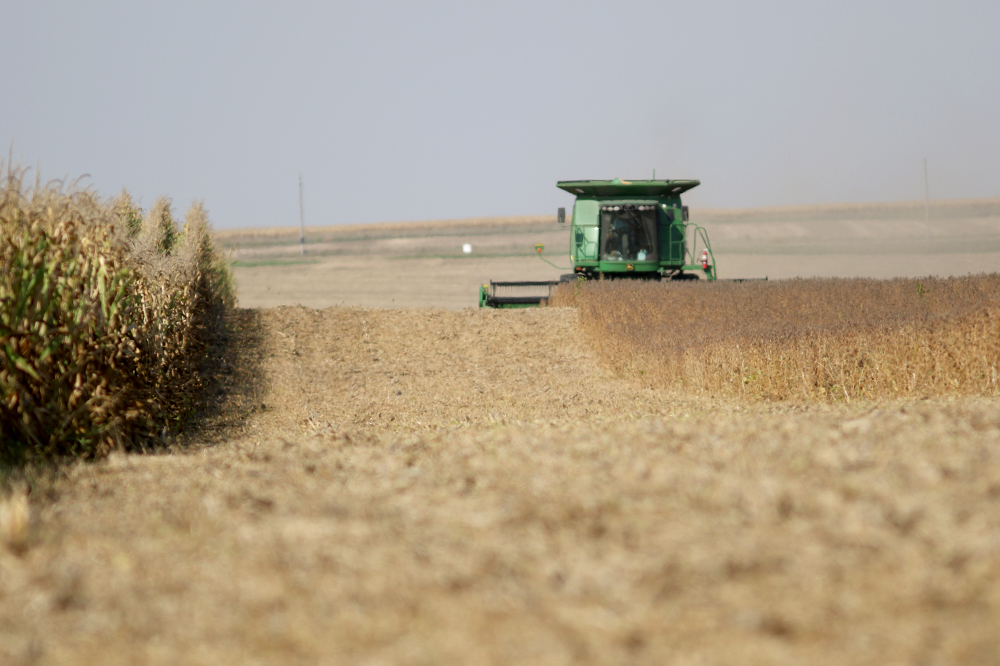
Formalized ownership of Iowa farmland is becoming more popular, but researchers say this is mostly due to succession planning. (Photo by Jared Strong/Iowa Capital Dispatch)
As agricultural land prices have increased drastically over the past two decades and young, want-to-be farmers have an increasingly difficult time starting their operations, politicians nationally, and here in Iowa, have questioned if corporate or foreign interests are to blame.
Iowa gubernatorial candidates Zach Lahn and Rob Sand both have said corporate or out-of-state ownership of Iowa farmland is a problem and have suggested policies that would tax Iowans at lower rates than out-of-state or investor landowners.
But ag land researchers say that much of the rise in formalized farm land ownership – through LLCs, trusts and corporations – is tied to succession planning and that the out-of-state or institutionalized owners are usually people with direct ties to Iowa.
A report on 40 years of land tenure and ownership in Iowa shows a “continuous shift” away from individual and joint ownership, to more trusts, limited liability companies and corporations. The most recent land survey, conducted in 2022, revealed 9% of Iowa farmland was held by LLCs, 6% by corporations and 23% by trusts.
In 2002, just 1% of farmland was owned by LLCs, 7% by corporations and 8% by trusts.
Why is the trend moving away from individual or joint ownership of farmland?
Rabail Chandio, an assistant professor of economics at Iowa State University who studies the domestic farmland market, said transition and succession planning was the “primary motivation” for the increase in “formal” ownership styles.
“Especially when farms are becoming larger, there are a lot of successors involved, there’s a lot of heirs involved,” Chandio said. “There’s a person who has three kids, each of their three kids has a few kids again. It’s very hard to divide a 1,000-acre farm eight ways or 10 ways and then operate it as a separate 100- acre operation in today’s economy.”
The report notes that nearly 40% of Iowa farmland is owned for “family or sentimental reasons” according to survey responses. This is an increase from 22% of land kept for this reason in the 2012 survey.
Chandio said as folks move away from Iowa, but retain ownership of their family land, putting the land in an LLC allows them to serve as a shareholder and receive a percentage of the returns from farming or from cash rents. Holding the land in a trust, she said, allows owners who are away from the farm to get a percentage of the farm’s returns, based on the stipulations of the trust.
Kristine Tidgren, the director for the Center for Agricultural Law and Taxation at ISU, said there are “really, really good reasons” from a legal perspective, for a family to put their property in an LLC. Tidgren said it gives owners liability protection and protects outside assets from things that happen with the land, and she said it offers “great” ways to manage and transfer property.
“It is a legal entity that is designed for managing a business, or property owned jointly for business purposes, and so it has built into it lots of provisions, and then it allows you to customize those provisions in ways that work best for your family,” Tidgren said.
For example, if a set of parents want to pass their farmland down to their children, but only one of the children wants to farm, holding the land in an LLC that is separate from the farming business would allow the non-farming children to receive some monetary interest from the property without interfering in the farming operation itself.
As part of the trend of more landowners living out of state, the 40-year farm survey analysis shows 58% of farmland is leased and nearly 80% of leased land is owned by non-farmers.
According to the report, over half, 55%, of farmland is owned by someone who does not farm, though this figure has remained fairly stable over the past two decades.
The report also notes that 25% of farmland is owned by someone who is either a part-time Iowa resident or not an Iowa resident. This is also a growing trend noted in the report. In 1982, just 6% of farmland was owned by folks who didn’t call Iowa home. By the early 2000s the share topped 20%.
Fourteen percent of all Iowa farmland owners were categorized as nonresidents, according to the report.
Iowa candidates for governor call for transparency, tax changes
Lahn, the Republican candidate for governor, has spoken about out-of-state and LLC land ownership along the campaign trail and said he would push for “human level disclosure” of land ownership in Iowa, if elected.

“We actually don’t know who owns our land in Iowa,” Lahn said on the Tucker Carlson Show in February. “There’s not human level disclosure that’s required, so you can own land in an LLC and that LLC could be wholly owned by a trust, and all the state knows is that the LLC owns the land.”
Chandio said in conversations she has had with farm managers and land appraisers – people who are regularly dealing with acres that aren’t owner operated – most of this is land not held by people with “out-of-state ownership that is not tied back to Iowa.”
“A lot of these people are the second-generation or the third-generation farmers who have inherited the land, but they themselves have a career elsewhere that makes them either not be a full-time Iowa resident or travel for work, and then these forms of ownership keep them tied to the land,” Chandio said.
Iowa’s ag land laws, Chandio said, also “generally keep” the majority interests in LLCs “in people who are in Iowa, farming in Iowa.”
Iowa’s anti-corporate farming laws restrict the types of corporations or LLCs that can own Iowa farmland. Iowa law allows for LLC ownership when the LLC is a “family entity,” meaning it is majority owned by people related to one another, was founded for the purpose of farming or owning ag land and can show that a majority of its gross income comes from farming.
The law also allows “authorized” entities to own farmland as an LLC but these companies are capped at 1,500 acres and can’t have more than 25 owners or beneficiaries.
Tidgren said Iowa’s restrictions are “stronger than most states” to prevent entities like real estate investment trusts from swooping in and buying up farmland.
“We have to look at the real facts and the real data, and it does not appear from the facts that Iowa farmland is being owned by out-of-state entities or foreign owners,” Tidgren said. “That that just doesn’t bear up under the facts.”
While there are “always exceptions to the general trend” and there might be some out-of-state owners with no ties to Iowa who are purchasing land, Chandio said she doesn’t think that’s a “big enough number to be concerned about.”
Why does it matter if land is owned by people out of state?
Lahn has said the growing share of out-of-state landowners in Iowa presents a “real generational issue” where people who own the farmland aren’t part of the communities. In an interview on Iowa PBS, Lahn said absentee landowners are usually the first landowners to agree to development projects that members of the local community might oppose.
“And the reason is, they’re looking at Iowa’s land as a cell in a spreadsheet,” Lahn said. “How much money can I make off this piece of land? They’re not looking to say, ‘What would this do to the community that’s surrounding it.’”
Dan Capodilupo, a spokesperson for Lahn’s campaign, said the issue is that “too often, LLCs are used to circumvent Iowa laws restricting certain types of ownership.”
“By requiring human-level disclosure, Zach will enforce the laws on the books, especially against foreign land ownership,” Capodilupo said in an emailed statement.
To help farmers who live and farm in Iowa, Lahn proposed lowering property taxes for Iowans and raising property tax rates on “institutional investors.”

Sand, the Democratic candidate for governor, has also proposed tax changes that would benefit buyers who stay in Iowa. In his “Opportunities for All” platform, Sand proposed taxing out-of-state landowners at a higher rate than people who live and farm in Iowa, as well as initiating a “ban” on “hedge funds and LLCs” purchasing “too much” Iowa land.
A Sand campaign spokesperson, Emma O’Brien, said in an email that “Iowa land belongs in Iowa hands.”
“The plan would make it harder for out-of-state land owners to use LLCs and hedge funds to buy up Iowa land while also taxing them at a higher rate,” O’Brien said. “But while Rob is looking to protect Iowans from out-of-state interests, Zach Lahn used his network of LLCs to buy up Iowa land while living in Kansas.”
Public record searches show that Lahn’s Belle Plaine farm house and surrounding properties are owned by Selah Group LLC or Selah Properties LLC, to the attention of Lahn. The LLC is also listed on properties Lahn owned in Montana.
Foreign-owned land in Iowa
Lahn has also said he would “confiscate” any land illegally owned by China and sell it to young farmers or veterans, if elected. Stopping foreign ownership of agricultural land has been a priority of the Trump administration with the launch of a National Farm Security Action Plan and an online portal to report foreign land ownership transactions.
“No foreign adversary should own Iowa farmland,” Capodilupo said. “Iowa land belongs in Iowa hands.”
An analysis from Chandio looking at federal Agricultural Foreign Investment Disclosure Act data, found that “foreign interest in agricultural land has grown over time” nationally, with an average 2.6 million more acres in foreign holdings, annually, since 2017.
At the national scale, foreign individuals and entities were reported as holding an interest in 3.5% of privately held agricultural land, but Chandio wrote that in the Midwest and Iowa, “foreign-held acreage accounts for an even smaller share of total land” due to strict agricultural land laws.
The report, and an interactive database from ISU shows the majority of foreign-owned ag land in Iowa is used for wind, solar or other energy uses.
Chandio’s report looked at AFIDA data from 2010 to 2023 and found that across the period, foreign ownership has remained under 2% of Iowa’s total agricultural land. Canada and Italy claim most of the foreign-owned land in Iowa.
Tidgren said there are “pain points” for beginning farmers trying to buy Iowa land, but she said it has to do with the price of land, not the entity that owns the land.
Part of this, she said, is because of tax laws that would require certain taxes on the land to be paid only when it’s sold, and because people are holding on to land for sentimental reasons.
“It’s a tough subject because again, there are just maybe some misinformation or just misunderstandings,” Tidgren said. “It’s sometimes difficult to even know how to assuage those fears.”