
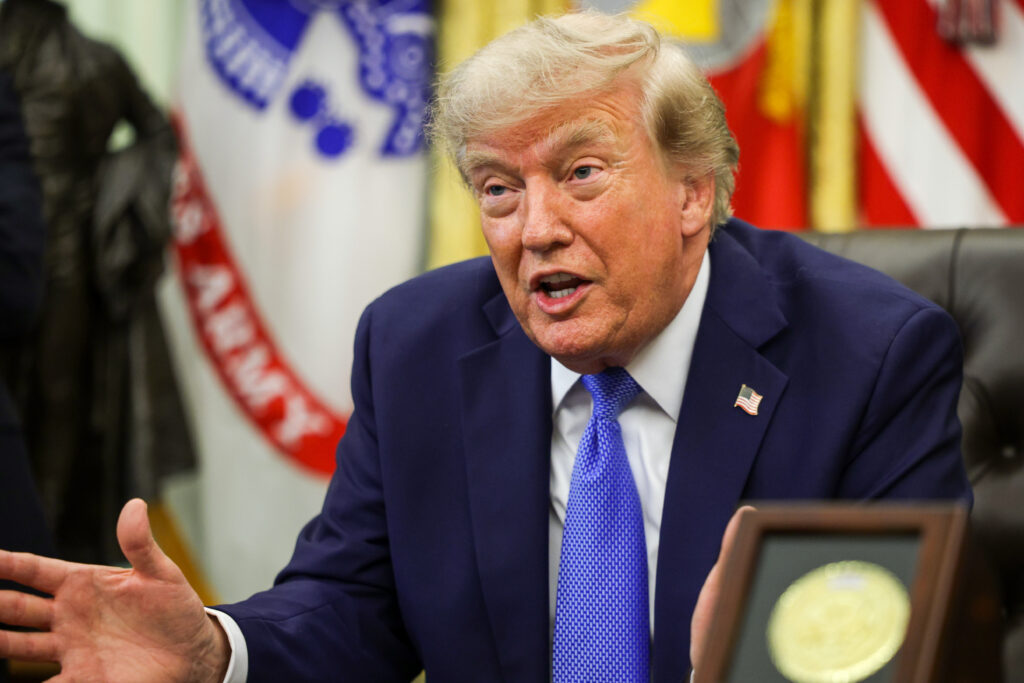

President Donald Trump speaks during an event in the Oval Office on August 6, 2026. Trump signed an executive order during the event denying birthright citizenship to children of foreign diplomats after a loss at the U.S. Supreme Court limited an earlier order. (Photo by Alex Wong/Getty Images)
WASHINGTON — President Donald Trump has not slowed his pursuit of central policy goals and personal pursuits, even after major setbacks at the U.S. Supreme Court and other federal courts.
The high court in its 2026 term delivered blows to Trump’s core campaign promises to upend a constitutional provision governing who becomes a U.S. citizen at birth and to swiftly address the growing national debt with “trillions of dollars” raised by taxing imports.
The justices also ruled the president cannot fire, without cause, Fed Board Gov. Lisa Cook and deny her a chance to plead her case. And a lower court blocked Trump from installing his name on the John F. Kennedy Center for the Performing Arts.
But even after the Supreme Court ruled against him, Trump is forging ahead and using what some legal observers describe as “creative lawyering” to find alternative routes to push his agenda, even as public support fades.
He ordered new blanket tariffs in late July on at least 60 trading partners. He signed a new round of birthright citizenship orders Aug. 6. Reports also revealed that Cook received a letter Aug. 5 from administration officials that Trump is again “considering” firing her.
The moves test the power dynamic between the executive and judicial branches, but are not illegal or even unconventional in modern times, experts said.
“They look at it and they say, ‘We want to advance a particular policy agenda. Here’s the whole array of legal arguments that we might be able to use that give us authority,’’’ said Scott Anderson, senior fellow at the centrist Brookings Institution and senior counsel and editor of the publication Lawfare.
Trump is not alone in this pursuit. After all, President Joe Biden found another route to student loan debt relief after a loss at the Supreme Court. A federal appeals court effectively axed the Biden-era relief program in March.
“It does happen, and (administrations) will sometimes run the risk of legal reversal, but it’s a rarer move,” Anderson said. “For this administration, it’s become the standard move.”
‘Spirit of the law’
While Anderson said Trump’s responses to the rulings are “not surprising” given the legal strategy of his second term, one could argue the “legal brinksmanship … often clearly runs contrary to some of the spirit of the law, and it capitalizes on a lot of institutional inefficiencies.”
Thomas Berry, a legal scholar with the libertarian Cato Institute, said while Trump has often used rhetoric to “delegitimize the court,” his recent actions are not out of legal bounds.
“What he’s doing is distinct from outright disobedience or ignoring a Supreme Court’s decision, and it’s important to stress that that line has not been crossed,” said Berry, who directs the institute’s Robert A. Levy Center for Constitutional Studies.
A White House spokesperson said the administration has “always followed court orders.”
“The Supreme Court’s ruling on the Cook case required notice and an opportunity for a hearing in considering whether the President should take certain adverse employment actions. The President’s notice sent to Fed. Governor Cook offers exactly that within the precise structure enunciated by the Court,” said Lauren Bis in a brief written response from the White House.
A Department of Justice spokesperson, who did not provide a name, wrote in a statement, “Investigative and prosecutorial decisions are made based on the law and the facts. To date, DOJ has prevailed in 24 emergency applications before the Supreme Court, winning over 80 percent, an unprecedented win rate that speaks for itself, and has also won dozens of merits cases at the Court.”
The spokesperson highlighted the department’s Supreme Court win in June that allows the administration to follow through with plans to deport between about 350,000 Haitians and 6,000 Syrians who were living in the U.S. under Temporary Protected Status.

Birthright citizenship
On the final day of its 2026 term, the Supreme Court rejected Trump’s sweeping attempt to deny citizenship to children born to parents who either do not have legal status or hold temporary legal visas.
Chief Justice John Roberts led the 6-3 opinion on June 30, writing that children born in the U.S. to parents who are unlawfully or temporarily present “are ‘subject to the jurisdiction’ of the United States and are citizens at birth under the Fourteenth Amendment’s Citizenship Clause.”
Today’s exceptions for those who are not subject to U.S. jurisdiction include foreign diplomats and their families, members of invading armies and in most cases foreign public ships passing in nearby waters.
On Aug. 6, Trump signed two executive orders again aimed at curtailing birthright citizenship. The first targets children born to the staff working for foreign diplomats; to children born in American Samoa, where Congress has yet to pass a citizenship law; and to the children born to parents who belong to what the U.S. defines as a “Foreign Terrorist Organization.”
“So what Trump is trying to do with these executive orders is he’s trying to say, ‘OK fine, those are the categories you’ve given us. We’re going to try to push those to the maximal extent possible,’” Berry said.
“And he interprets them broadly,” Berry continued. “Do people have diplomatic immunity or not? That’s kind of a factual question. Literally the ambassador and the ambassador’s spouse, they get diplomatic immunity. But does everyone from the foreign country working in the embassy similarly get immunity from U.S. law? That wasn’t my impression.”
Trump is also seeking to limit birthright citizenship by taking what Berry described as a “maximalist view” of what an invading army is.
“It’s not obvious that that analogy extends to people who are part of designated terrorist groups because they’re not literally rampaging and pillaging,” he said. “This is more people who are living here but have been, you know, labeled as part of a group that’s at odds with the United States.”
Anderson said the administration “clearly is intending to just take advantage of every hint and every limitation the Supreme Court decision left open.”
The American Civil Liberties Union on Aug. 12 began the process of asking the federal judiciary to reaffirm the Supreme Court ruling.
Tariffs
Trump’s trade policy provides another example of the administration finding a new legal reasoning after the Supreme Court struck down the initial basis for a major administration goal.
In the midst of refunding roughly $166 billion to businesses that paid taxes on imports under Trump’s emergency tariffs, the president has hopscotched across multiple trade statutes to continually impose at least 10% duties on most global goods since his Supreme Court loss in February.
In a 6-3 opinion, the high court struck down Trump’s unprecedented claim of tariff authority under the 1977 International Emergency Economic Powers Act. Congress retained tariff authority in most circumstances, Roberts wrote for the majority, and Trump could not use the statute to impose duties after declaring emergencies on trade imbalances and illegal drug smuggling.
Trump lost the case to a handful of small business owners and Democratic state officials. Tariffs are taxes paid by the importers, meaning American businesses were shouldering the additional costs.
Trump immediately turned to another statute, Section 122 of the Trade Act of 1974, which authorizes the president to unilaterally set up to 10% in tariffs for 150 days.
The order set off another round of legal challenges, including from Democratic-led states, in the U.S. Court of International Trade.
Less than a month after the Supreme Court loss, the U.S. Office of the Trade Representative also opened broad trade investigations under Section 301 of the 1974 law into the practices of nearly all U.S. trading partners.
As the clock ran out on Trump’s 10% blanket tariff under Section 122 on July 24, U.S. Trade Representative Jamieson Greer announced his office had found forced labor practices by roughly 60 of America’s trading partners, including Canada, the European Union, Japan, Mexico, South Korea, Taiwan and the United Kingdom, among dozens more. The findings triggered a 10% to 12.5% duty on most goods from those countries.
Days earlier, Trump announced he would use a Depression-era provision that had never been enforced — Section 338 of the Tariff Act of 1930 — to slap a 50% duty on most Canadian imports. The U.S., for now, has delayed the start of the high tariffs as talks with Canada continue, according to reports.
Trump’s strategy on pushing tariffs is “not really surprising at all,” Anderson said, adding “it’s not even inappropriate.”
“The Supreme Court never said, ‘You can’t do tariffs.’ In fact, it said basically you can. It just said ‘You can’t do it this way.’ And that automatically points to these other ways, which everyone said is probably a more sound way to do this if the president really wants to do this,” Anderson said.
“It doesn’t mean it’s good policy,” he added. “It doesn’t mean it’s a good idea, but there’s at least a very colorable case the president can do this all legally. ”
2025 deportation flights
Trump’s “aggressive” legal strategy has set him apart from other presidents, and, despite specific recent examples that haven’t crossed a legal line, the administration likely violated court orders in relation to immigration, according to observers.
“I think there are some cases that push the envelope, might be unlawful, particularly around, like, some of those early deportations,” Anderson said. “But the majority of the time, the executive branch has been responding and complying with court orders. It’s capitalizing on the fact that those orders are often very narrow.”
Berry also highlighted the March 2025 deportation flights that took off with hundreds of immigrants on board despite a court order as a potential example of cases “where these agencies have outright violated court orders.”
Overall, the courts have been a check on the administration’s view of expansive power, both experts said.
“It is worth taking a moment to realize, like, just how vastly smaller the scope of this (most recent) birthright executive order is after the Supreme Court,” Berry said. “The decision did cut off the vast majority of options the administration has. I mean, you think about the scope of millions of people that the original order would have affected, and compare that to this. It’s just night and day.”
Electorate another check
Voters are also a check on power, observers say.
With crucial midterm elections approaching, Trump’s net approval rating is -26, meaning the percentage of voters who approve of him is 26 points below those who disapprove, according to The Economist/YouGov poll figures published Aug. 18. A Reuters/Ipsos found Trump’s approval rating at a record low of 33%, according to data published Aug. 17.
A recent Fox New poll last month showed most voters disapproved of Trump’s handling of the economy. And 55% told Reuters/Ipsos just days before the Supreme Court ruling that they disapproved of Trump’s attempt to end birthright citizenship.
Trump surrounded himself in his second term with people who “openly denigrated” a lot of norms of the executive office and are “acting accordingly” to what they saw their voter base wanted, Anderson said.
“I think they probably overreacted to this idea that simply by winning the last election, that voters have a high tolerance for this,” Anderson said. “And Republicans in Congress and potentially in 2028 are going to pay a price for that.”
Anderson added if voters and lawmakers don’t like the loopholes Trump’s legal strategy is employing, then maybe it’s time for Congress to close them.
“If we don’t think our laws align with what we think is right ethically and good policy, then maybe they do need to be adjusted,” he said.
“Maybe if we want a robust separation of powers, we need to take actions that will empower the courts and Congress to push back on executive aggrandizement more effectively, as opposed to the trajectory over the most of the 20th century, which was implicitly, sometimes expressly, more or less empowering the executive branch on the assumption that the executive branch was going to self-constrain itself.”
‘Everything people don’t like’
As for the Kennedy Center: Despite a judge’s order that led to the yanking of Trump’s name from the facade of the revered performing arts venue in mid-June, Trump’s hand-picked board voted Aug. 13 to again affix his name to the building.
This time, instead of above John F. Kennedy’s name, the board voted to add an inscription underneath to read “The John F. Kennedy Center for the Performing Arts Restored and Renovated By President Donald J. Trump,” according to court records.
A federal judge had found that Trump’s name, which had already been added, could not officially remain there without authorization from Congress.
“It’s sort of everything people don’t like about lawyers at its extreme. … This is kind of again looking for a loophole — they’re going to argue ‘We are not naming the center. We are adding this appendage,’” Berry said.
“So long as it’s just like naming the renovation, you know, kind of like a sponsorship deal at the end of the name of a stadium or something like that, that’s acceptable because it’s not renaming the center,” he continued. “So we’re likely to have litigation about that too, and it’s going to be a pretty lawyerly and probably annoying debate.”