
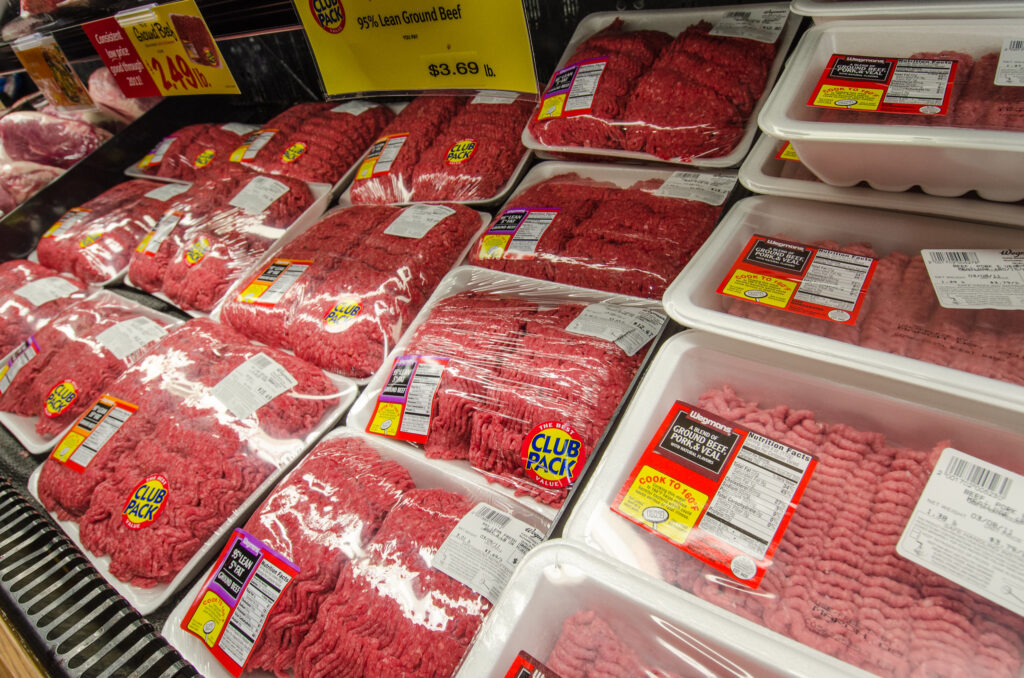

A bipartisan bill would reverse a presidential decision to allow more foreign beef into the U.S. (Photo by Lance Cheung/USDA)
U.S. Rep. Zach Nunn is calling for the suspension of President Donald Trump’s initiative allowing more foreign beef into the U.S. and for congressional oversight of future beef import decisions from the executive branch.
Nunn announced a bipartisan bill Wednesday, with Democratic Rep. Gabe Vasquez of New Mexico, aimed at increasing domestic beef and lowering consumer prices of the protein.
The Banning External Entry of Foreign Beef, or BEEF Act, would also create a Beef Import and Domestic Supply Advisory Board, that would be tasked with developing a strategy for rebuilding the U.S. beef herd which has declined significantly in recent years.
“Lowering beef prices for Iowa families and supporting our cattle producers should go hand-in-hand,” Nunn said in a news release. “If we want more affordable beef for the long term, we need more American beef being raised and produced here at home.”
The bill follows a move from the Trump administration to suspend tariffs for 90 days to allow up to 300,000 metric tons of imported ground beef into the country, saying it would help lower the cost at the grocery store.
Under the bill, this action from the president, and “any successor or substantially similar proclamation” would be null unless approved by Congress.
“Cattlegrowers in New Mexico and across the nation have made it clear – they want to reverse the President’s foreign beef imports and they need more time, and more tools, to grow their herds and fix the domestic supply chain,” Vasquez said in the release.
Growing domestic herd
Shortly after the president’s announcement to import ground beef, the U.S. Department of Agriculture launched a “Ranchers First Initiative” with tools to support heifer retention, build up grazing land, revitalize local processing facilities, support new ranchers and prioritize U.S. raised beef in government food budgets.
USDA said the plan would help to rebuild the U.S. cattle herd which it said is currently at a 75-year low.
The beef advisory board that would be initiated under the BEEF Act, would “complement” the recent USDA initiative, according to the news release, by coalescing cattle producers, processors and industry experts as an advisory board to consult with the department and Congress.
Per the bill text, the advisory board would be tasked with developing a plan to rebuild the U.S. cattle herd, increase domestic beef production, cut red tape for U.S. ranchers and keep beef affordable for consumers.
While the cattle herd has been shrinking with drought and consolidated markets, the price of ground beef has been on a steep increase since 2023. U.S. Bureau of Labor Statistics data show the price of ground chuck has not dropped below $6 per pound since April 2025. As of August, the average price was $6.77 per pound.
A group of U.S. lawmakers, including Nunn, previously wrote a letter to Trump, urging him to consult with cattle producers and stakeholders before making policy changes that impact the industry.
“Our bipartisan bill puts producers at the table to develop a long-term plan to increase our domestic beef supply, while giving Congress a say before future decisions are made to expand foreign imports,” Nunn said.
Nunn, a Republican, is facing a competitive race for reelection in Iowa’s 3rd District against Democratic state Sen. Sarah Trone Garriott that national political forecasters have rated as a “toss-up.” It’s the second time in just over a week that Nunn has publicly broken with Trump — he was one of seven Republicans who supported a war powers resolution Sept. 16 that would require congressional approval for further military action in Iran.
Calls for Trump to hold China to ag deals
As Trump prepares to meet with Chinese President Xi Jinping at the White House this week, agricultural groups have urged the president to hold China to trade agreements, particularly agreements to purchase U.S. soybeans.
The American Soybean Association and National Sorghum Producers sent letters to the president urging trade negotiations to remove China’s retaliatory tariffs on U.S. agricultural goods and to strengthen commitments to purchase agreements.
Previous meetings between the presidents have resulted in annual purchase agreements of U.S. soybeans and other agricultural products. A meeting last October resulted in a Chinese commitment to purchase 25 million metric tons of U.S. soybeans in 2026, 2027 and 2028.
American Soybean Association President Scott Metzger said soybean producers need “consistency and predictability” in the Chinese export market.
“That means ensuring China fulfills its purchase commitments, addressing barriers that put U.S. soybeans at a competitive disadvantage, and working toward a durable trading relationship,” Metzger said in a statement.
In the letter, the association estimates China has ordered 15.5 million metric tons so far this season.
Nunn also called for Trump to use his “leverage” in the trade meetings with Xi to “demand real results for Iowa farmers and American workers.”
In May, the White House announced that China had agreed to purchase an additional $17 billion in agricultural products, annually, over the same time frame as the soybean deal. USDA data from July show 2026 Chinese purchases of U.S. agricultural products, excluding soybeans, was less than $4 billion.
“I pushed the administration to secure China’s commitment to reopen its market to American soybeans earlier this year, and that was an important win for Iowa farmers,” Nunn said in a statement. “But it’s clear we can’t take Beijing at its word. Any new trade agreement should be enforceable and open markets for American products without giving China more leverage over our farmers, manufacturers, or national security.”
Trump’s meetings with Xi are expected to begin Thursday.