
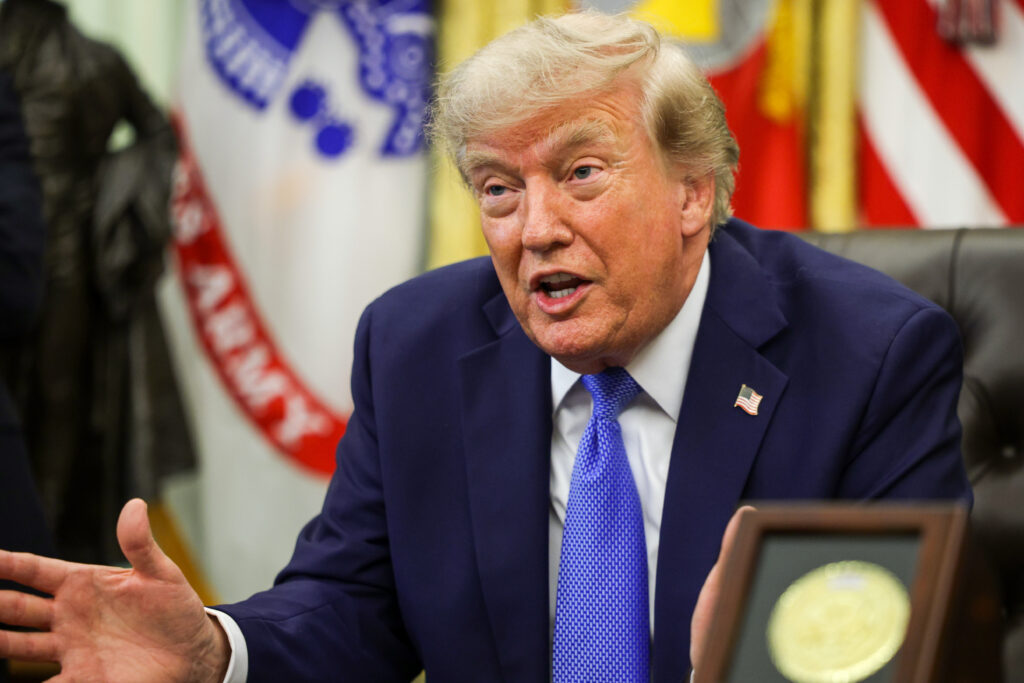

President Donald Trump speaks during an event in the Oval Office of the White House on August 6, 2026. (Photo by Alex Wong/Getty Images)
WASHINGTON — President Donald Trump will likely veto many of the bills that Democrats pass once they take control of Congress next year, he said Friday, though he suggested negotiations on healthcare and immigration were possible.
“They’re going to send things my way and I’m going to veto them. And then they’re going to send more things and I’m going to veto them,” he said. “But I think after a month or so, they’re going to send things, and I’m going to say, ‘I’m going to veto unless you want to do this and this and this.’”
Trump then referred to House Speaker-designate Hakeem Jeffries and Senate Democratic Leader Chuck Schumer, both of New York, as “smart” and indicated he would be willing to work with them on some issues.
“There is a real possibility that we get a lot of great things done, especially on healthcare. I am open to great healthcare,” he said. “Now, can it be what they want? No, but it can be a combination of what we all want, and we could end up with great healthcare in our country. We could end up better than dealing with the Republicans.”
Trump said several Democrats have called him in recent weeks, including Texas Gov.-elect Gina Hinojosa, who he said wanted to discuss border security.
“I received a phone call two days ago from the new governor-elect of Texas. She was really nice. It was a very productive call, and she wants to have a strong border,” he said. “And I think we’ll be able to work something out because that’s a very important thing.”
Must-pass items
Trump and Democratic leaders in Congress will need to negotiate much more than healthcare and immigration once divided government begins in January.
They will need to work out bipartisan agreement on the dozen annual government spending bills that fund scores of departments and agencies as well as the thousands of programs they administer. Failing to accomplish the work, or approving a stopgap spending bill instead, would lead to yet another shutdown.
Congress and the White House will also likely need to negotiate another debt-ceiling increase early next year. Without agreement, the country would default for the first time in modern history, very likely plunging the economy into a tailspin.
Not addressing the debt ceiling before the remainder of the $5 trillion in new borrowing authority approved by Republicans in last year’s “big, beautiful” law expires would limit the federal government to only spend what it brings in.
That would lead to ramifications more significant than a government shutdown, including the possibility that Social Security checks would not go out on time and that medical providers wouldn’t be reimbursed for Medicare or Medicaid patients treatment.