
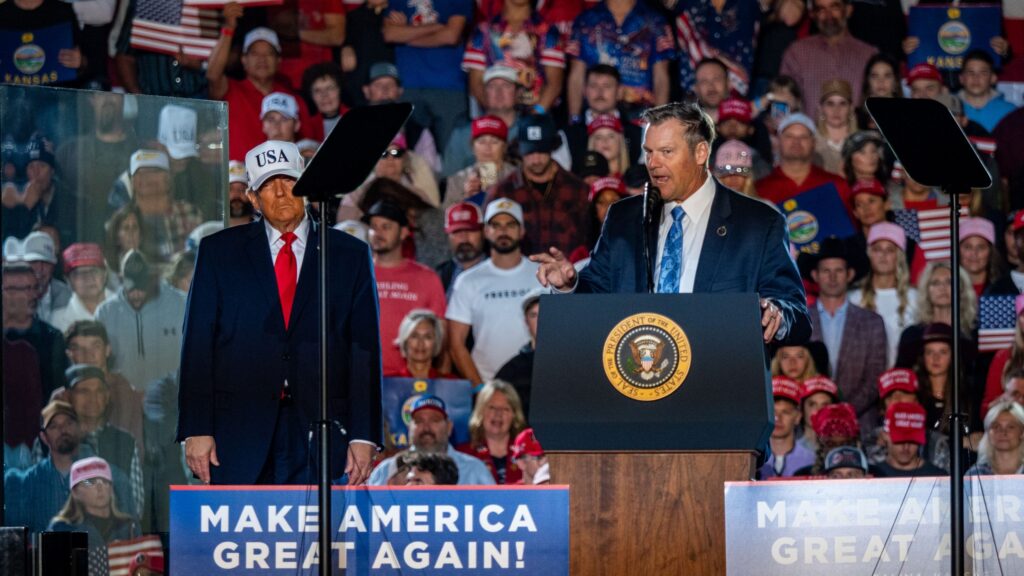

Kansas Attorney General Kris Kobach speaks alongside President Donald Trump at a Nov. 1, 2026, rally in Salina, Kansas. (Photo by Sherman Smith/Kansas Reflector)
Ahead of the midterms, Democrats wargamed dozens of scenarios looking at how President Donald Trump might try to undermine the election, everything from seizing voting machines to falsely declaring a foreign attack.
But when the blue tsunami arrived Tuesday night, Trump seemed to let it wash right over him.
In a series of late-night interviews, the president said he would accept the results. He acknowledged that Democrats had performed well as they retook the House and Senate. And while he refused responsibility for Republicans’ newfound misfortune, he also spoke of cutting deals with Democrats.
“Yes, I’ll accept them,” Trump said on Fox News when asked about the results. He added a short time later, “Congratulations to the Democrats, they did a good job.”
The comments marked a stunning departure for a mercurial president with a long history of alleging elections were stolen in response to unfavorable results.
They also stood out because this year’s midterms were his first election while in office since 2020, when he led a campaign to overturn his loss that helped spur the mob that sacked the Capitol on Jan. 6, 2021.
“My first thought was, ‘Well, I’m glad that’s on tape,’” Pamela Smith, president and CEO of the election security nonprofit Verified Voting, said in an interview.
Fears of federal interference
Election officials spent months planning for the possibility of federal election interference on Election Day. After the FBI seized ballots from the 2020 election in Fulton County, Georgia, in January, state and local leaders across the country weighed how they would respond if the Trump administration tried to take their ballots or voting equipment.
They mapped out what poll workers would do if federal agents showed up at the polls. Some states even passed new limits on federal law enforcement and military servicemembers at the polls, even though federal law already prohibits armed personnel at election sites.
“There have been so many different kinds of threats and it’s just been so far to get to this day, far too hard for the election officials,” Smith said Wednesday.
None of those extreme scenarios came to pass on Election Day. Instead, Democrats won resounding victories up and down the ballot.
As of midday Wednesday, Democrats had secured 54 Senate seats, according to The Associated Press. Democrats had also won at least 228 seats in the House, well above the 218 necessary to control the chamber.
The not-close race for control of Congress and a high voter turnout “made it impossible to challenge these results,” David Becker, executive director of the nonpartisan Center for Election Innovation & Research, told reporters.
Trump blamed the loss on his absence from the ballot, even though he had exhorted Americans to vote as if he were on the ballot. Vice President JD Vance blamed the war with Iran.
“The main problem is that many people who voted for Trump/Vance in 2024 voted for Democrats in 2026,” Vance wrote on social media.
Both men sought to explain Republicans’ deep losses — not claim that they didn’t happen.
Ballot fight consumed officials
But despite Trump’s pledge to accept the results, voting rights advocates said the Trump administration very much attempted to interfere ahead of Election Day and influence how states ran their elections.
The U.S. Department of Justice sued California over the ballots of 20,000 suspected noncitizens and Alaska over alleged voter confusion in the U.S. Senate race.
California election officials had warned the Justice Department’s demand would have thrown the election into chaos and the U.S. Supreme Court rejected the request Monday. Meanwhile, a federal judge tossed the Alaska lawsuit on Sunday.
Justice Department lawyers raised the possibility that election officials could be prosecuted if they counted the ballots of noncitizens or if they failed to follow federal recordkeeping laws. They issued subpoenas to election workers in Los Angeles County, demanding records that suggest prosecutors are examining whether election officials were “aiding and abetting” noncitizen voters.
The DOJ also sued dozens of states for unredacted copies of their voter rolls containing sensitive personal data. Federal judges have rejected those lawsuits in at least 27 decisions so far, and the Trump administration has won none of its cases.
The U.S. Department of Homeland Security ran election-related field operations that federal judges found could intimidate voters. The department also launched a powerful computer program to identify possible noncitizen voters, but Democrats and election experts said its results were unreliable and prone to falsely flagging U.S. citizens.
More broadly, Trump urged GOP state lawmakers across the country to redraw their congressional maps to be more favorable to Republicans — a process that accelerated after the Supreme Court weakened limits on racial gerrymandering. But in Alabama, North Carolina, Texas and elsewhere, the new maps did little to shield GOP candidates.
Earlier this year, Trump also pushed the U.S. Postal Service to impose restrictions on mail ballots, a move blocked by the Supreme Court. And he unsuccessfully demanded Congress pass the SAVE America Act, which would have immediately imposed stringent rules requiring voters to prove their citizenship, leaving states with no time to prepare.
“Despite unprecedented executive branch efforts to interfere in election administration, state and local officials responsible for running our elections have continued to do their jobs and uphold the process,” Michael McNulty, senior policy director at Issue One, a group focused on protecting American democracy, said in a statement.
Some legal wrangling continues
Trump’s admission of defeat may not fully end his administration’s pressure campaign over elections.
Late on Election Day, the Justice Department secured a rare court victory when the U.S. 9th Circuit Court of Appeals affirmed a decision by a three-judge panel removing limitations on the Trump administration threatening election workers with prosecution.
The decision came after a federal judge in California last week issued an order prohibiting the DOJ from threatening election officials with criminal charges if they didn’t comply with demands related to setting aside the ballots of alleged noncitizen voters.
“We will conduct our criminal investigations without fear or favor,” Bill Essayli, first assistant U.S. attorney for the Central District of California, wrote on social media Tuesday.
The Justice Department’s lawsuit seeking to require California to set aside the ballots of 20,000 suspected noncitizens also remains unresolved. Even though the Supreme Court declined an emergency request by the DOJ, a federal judge has scheduled a hearing on Nov. 13 to examine the list that could include witness testimony.
The consequences of any ruling now aren’t clear. California’s ballots are currently being counted, meaning it would be effectively impossible now to identify whether a ballot came from a suspected noncitizen. The hearing will take place several weeks before election officials must certify results, however.
The hearing could reveal new information about how the Trump administration developed the list. The DOJ has said Homeland Security compiled it based on a public copy of California’s voter roll that was checked against government records and data from the Lexis Nexis research service.
California election officials have said they’ve found evidence that U.S. citizens are on the list, and in a court hearing on Monday, a Justice Department attorney acknowledged it has a “high error rate.”
Jonathan Miller, chief program officer of Public Rights Project, which represents Los Angeles County in the lawsuit, in a statement framed the dispute in simple terms.
“State and local officials run our elections — and the federal government cannot interfere,” Miller said.