

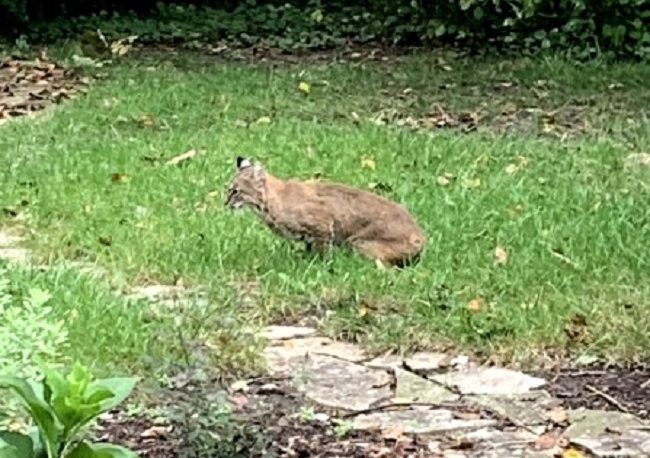
A local Perry couple was surprised to see a bobcat in their backyard Sunday afternoon. The man said it was on their property near the Perry Airport for about 10 minutes.
When they first saw the bobcat, it was standing in the open on their lawn, looking at their hedge of lilac bushes. They watched it groom and stretch like a common cat. It sat for awhile, long enough for them to take several pictures of before it walked away into the woods in the direction of a nearby creek.
Bobcats have always been in Iowa. During the time when Iowa was being settled, from 1850 to 1900, the number of these animals began to decrease due to hunting pressure and habitat loss. Iowa counties recorded bobcat bounties from 1860 to 1880, but payments declined significantly by the turn of the century due to decreased sightings.
Biologists think that by the 1900s the bobcats had nearly disappeared from the state. Biology Professor James Dinsmore of Iowa State University, in his book “A Country So Full of Game,” writes about many interesting accounts of bobcats in Iowa and their contact with people during the period when Iowa was being settled.
In the 1920s the bobcats’ population numbers began to increase. This was probably due to better enforcement of game laws and less hunting and trapping pressure because people were leaving the farms and moving to the cities. Today bobcats have been reported in almost all of Iowa’s counties. Their greatest numbers are in the southern two tiers of counties and in northeast Iowa. There have been several sightings of bobcats in Dallas County.
Their diet consists mainly of squirrels and small rodents. Only 10% of their food is birds. However, they are opportunistic, and they have been known to eat almost anything, including fawns and carrion. Like other wildcats, they will cache food, cover their kill with leaves and return later to feed.
Bobcats hunt by using their keen eyesight and excellent hearing. Their sense of smell does not seem as well developed as coyotes and foxes. Like house cats, they stalk their prey slowly and with stealth until they get close enough to make the final four- to five-foot leap.
Many people have reported seeing them on the local bike trails. It is not common to see them because they are nocturnal and secretive in the wild. Occasionally they can be heard calling at night during their mating season in late winter. Their call has been described like a screaming child, and they also give deep mournful meows similar to a house cat in heat.
Bobcats don’t attack people. The animals run and hide when people come near them. If you see one of these magnificent animals, please don’t disturb it. We want to coexist with them.