

Like hundreds of communities across the nation, Ames is in the midst of a debate about whether to approve construction of a data center, with intentions questioned on all sides.
On June 7, the Ames City Council heard a proposal that would dominate discussion for the rest of the summer.
Lightedge, an IT infrastructure company located in Des Moines, requested the city council approve its proposal to lease municipal land located at the airport on Aviation Way to build a 25-megawatt (MW), 10.86-acre, closed-loop cooling edge colocation facility.
The company shopped around the Ames area for property before it submitted its proposal for the airport location to city staff in May. Lightedge Chief Marketing Officer Matt Biegacki said this location allowed for tighter city regulation and a chance for the city to bring in higher rental revenue.
“I think the … thing that really changed this one is, the city reached out to us saying, ‘Hey, we’ve got 10 acres on the airport. Do you want to go use that? Because typically we would buy 10 acres of private land,” Biegacki said.
The proposal claimed that if the city accepted their colocation — rented spaces to hold servers and hardware — the project would create a benefit to Ames.
In a letter to the council, Lightedge Chief Executive Officer Rob Carter wrote that the colocation will “generate tax revenue without adding demand for housing, schools or other population-driven services. More importantly, it puts modern digital infrastructure in place for the companies already here and for the ones considering a move to Ames.”
Lightedge’s interest meets swift citizen opposition
The initial council meeting in June left the community with more questions than answers. This led to a listening session where the city staff and council heard questions and concerns from the community.
Of those who attended the listening session, more than 80% indicated they were not supportive of Lightedge’s proposal, while 5% said they were. The rest were undecided. Residents raised concerns about water usage, the center’s environmental impact and the cost of operation or accidents.
At the following city council meeting in July, the council learned just how much power it actually has to control a proposed data center, as city attorneys presented a legal breakdown of the limits the city faces.
This resulted in the council voting to delay its decision for nine months, pending further study of the issue.
A protest by the Heart of Iowa Democratic Socialists of America (DSA) preceded the council meeting. The group’s petition, “Don’t build data centers in Ames,” garnered more than 4,000 signatures.
“My biggest concern is that data centers are extractive from the communities where they are built,” said DSA Membership and Outreach Coordinator Aaron Lynch. “They extract from our public goods, from our public water, from our public power, from our public lands. … They socialize the risk to all of us, and then privatize the profits in the hands of big capitalist investors.”
Questions gained traction over the summer. Concerned community members demanded answers about potential effects relating to artificial intelligence (AI), water impact, electricity and what the addition of a data center would mean for the future of Ames itself.
How citizen involvement changed the conversation
Though residents opposed the project, Biegacki said Lightedge is glad to see citizen involvement.
“The willingness to kind of go in and say, hey, there are certain areas that I’m willing to dig my heels in and say we need better answers to that stuff,” Biegacki said. “I think it is a trait of a very healthy community and a very passionate population, which is great to see. It takes a lot of energy. I take a lot of faith from the fact that you’ve got people wanting to raise their hand.”
Ames Economic Regional Alliance Director of Business Development Dylan Kline worries citizen backlash influenced the council’s decision and silenced those who are in favor of the project.
“I think that there was so much political pressure that the council wasn’t willing to look at the project on its merits,” Kline said.
Kline fears heavy opposition puts pressure on those in favor to stay silent.
“And because of the heat around that discussion, the microphone that was given to the naysayers or the negative, the people who were in favor of it were silenced,” he said. “I was at the input session. I’m in favor of the project. I think it’s good for the community, but I didn’t feel comfortable getting up in front of such a venomous group.”
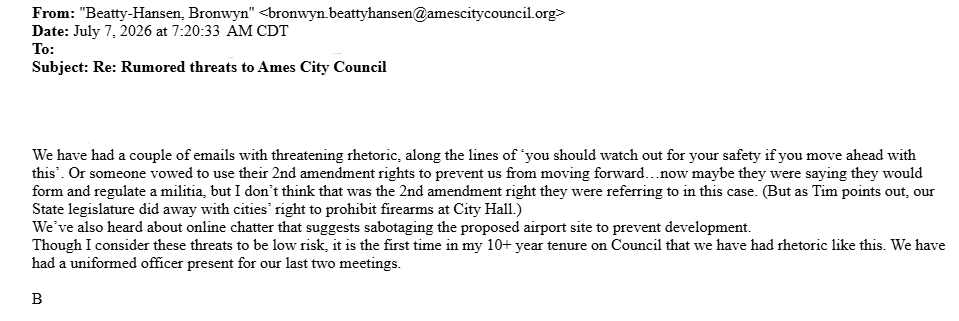
In the months after the announcement, the city council was flooded with emails sharing residents’ disapproval, some of which bordered on threats.
In an email obtained through an open records request, a council member admitted that, while the threats were low risk at the time, an officer was stationed during meetings as a precaution.
The DSA denied any attachment to the threats.
“I think it’s very important to know that within our coalition and within the Heart of Iowa DSA, we have never made any kind of threatening rhetoric part of our movement, and that rhetoric is not welcome in our movement,” Lynch said. “If you’re encountering folks out there making claims like this, they’re categorically untrue.”
Even with the for and against sides clambering to be heard, one thing is for certain: never has citizen involvement been so high.
Ames resident Darian Everding encourages people to continue involving themselves long after the data center issue passes council members’ desks.
“I think it’s really lovely that so many people have stepped up to be involved, to attend council meetings, and get really engaged in this one topic,” Everding said. “The more we can stay engaged, the more our voice is heard, the more we can stay ahead of things that are happening elsewhere in the community to keep Ames on the cutting edge and the visionary side rather than the reactive side.”
Lightedge feels like a stranger to Ames
For many citizens, the idea of a data center was an immediate no — at least one of this scale, as Ames is already home to two.
The project’s prospects weren’t helped by the lack of familiarity and trust people have with Lightedge. Among the concerns expressed about the company was the feeling it is too far away to feel the potential costs.
“I don’t know them, and I think that’s the primary concern for a lot of folks,” Everding said. “They don’t live here. They don’t deal with the consequences of their actions in the way that people who operate and own small businesses in this town do.”
Other residents are concerned Lightedge is not accurately representing who it is, with outside interests pulling the strings.
“It presents itself as a Des Moines regional operator, but five years ago it was bought out by GI Partners,“ Lynch said. “And that private equity firm is owned at least in a significant strategic minority of shares by the Blackstone Group.”
Lightedge opened in 1996 in Des Moines. In 2021, it entered into an acquisition deal with a private equity firm from San Francisco, GI Partners.
The company acknowledges the concerns, but says it is still the same operation it was in 1996.
“Look, I get it,” Biegacki said. “Private equity is around, yeah, it ruins everything. It’s the worst. I hate it. It’s also one of the realities that you have with a lot of the companies. For me, it’s always looking at … who are the folks that are working in our communities and advocating for us? And for the most part, you still have that with Lightedge.”
Ames should see the benefits Lightedge may bring to the community, Kline said, and giving the project an immediate no without consideration may be a missed opportunity.
“They weren’t asking for any incentives,” Kline said. “They were just looking to invest in this community, and then also looking for ways that they could, in addition to building their building, invest in other things … and those people that come with a no miss out on all the benefits of a project if they don’t evaluate it on its merits instead of making assumptions.”
While Lightedge strives to gain the community’s trust, Ames residents, like those in many communities around the country, continue to have concerns about data centers and AI in general.

Citizens skeptical of non-AI facility claims
For its proposal, Lightedge claims its colocation center will not be an AI data center, maintaining that the Ames location’s focus will be on housing data and supplying support for the community.
Yet this claim raised even more concerns.
Lynch questions the company’s motives, based on evidence of Lightedge’s offered services in GPU colocation for AI.
“They really emphasized that this isn’t an AI data center,” Lynch said. “But if you go on Lightedge’s website, what you’ll find is in big bold letters: ‘Lightedge colocation built for AI.’ Either they’re misrepresenting themselves to their customers and investors, or they’re misrepresenting themselves to the people of Ames. And neither of those behaviors makes for a good neighbor in our town.”
Everding is also skeptical of the validity of Lightedge’s claim. They are of the belief that the facility size and energy maximum would be key for future AI endeavors.
“This facility, the only thing that it would be economically viable to use at that scale, at the full 25 megawatt buildout, would be artificial intelligence,” Everding said. “Pouring the lifeblood of our communities into a project designed to take away our livelihoods seems completely backward to a lot of people and to me.”
AI concerns of this manner are unfounded, said Biegacki. He asserts that the facility, with its closed-loop cooling system, would not be able to handle cooling AI servers.
“The number one flag of, ‘Hey, are you in an AI data center?’ is your support of a GPU-based server,” Biegacki said. A GPU is a Graphics Processing Unit, a high performance server used in situations that need lots of working power, like AI. “Those are the data centers that are using millions of gallons of water every day. There’s no way for you to physically cool that type of server that is going to run that type of workload on a closed-loop chilling system like we have.”

Another concern: the cooling system
Water is one of the major concerns citizens around the nation have expressed with the growth of data centers.
Data centers, more specifically AI-focused ones, are known for using high amounts of water, necessary to cool the systems.
A large data center can use as much as 5 million gallons of water a day. In hyperscale facilities, this amount can be nearly 15 million gallons. On-site water usage comes down to the type of cooling system involved.
Lightedge proposed a closed-loop cooling system. The system is designed to use zero gallons of water a day and 10 gallons a year.
Closed-loop system centers are cooled using fans and recycled water. Lightedge says any water disposed of will be done through a water reclamation plant; it will not be placed into public water sources.
Water will only be topped off, besides the maximum 10 gallon per year estimate, if maintenance is required.
“That closed loop joint, you got to really just think about that the same way that your own home’s air conditioner works,” Biegacki said. “The same process goes into there, and that’s why when we were coming back and saying, hey, our overall water usage looks so insignificant compared to any of these guys that are supporting these GPUs … because we’re just running an air conditioning system.”

Lu Liu, assistant professor of civil, construction and environmental engineering at Iowa State University, thinks it isn’t the internal water use that’s cause for concern. It’s what’s happening off-site.
“They talked a lot about on-site water use, and it’s just water used for cooling,” Liu said. “But the off-site water use is the water that cools the power plant that supplies energy to the data center, and that is actually a much bigger portion of the water use. … Data centers may not worry about off-site water use, but the city has to at least consider it because that’s water.”
If Lightedge were to receive energy from Ames’ power plants, Liu said, water would need to be utilized to cool those plants. This water, Liu said, would be three times the amount Lightedge would use at their facilities.
“The city has to supply that energy, which means that the power plants, if they already have enough capacity, will also need to have more cooling water,” Liu said. “If they don’t, they will need to expand their capacity. So that’s additional investment. Those are the things that are not mentioned in the fact sheet.”
The amount of energy and thus water could dip or rise depending on the number of megawatts the location hits.
“I don’t have enough data to make a conclusion about whether this is a wise investment for Ames,” Liu said.
What the three phases mean for energy consumption
In a three-phase plan set out for the next 10 years, Lightedge has written that the proposal will aim to hit 25 MW of power.
Citizens fear both that Ames doesn’t have the capacity to withstand a system that needs so much power, and that the repercussions of that power will be shunted to them.
“I was very concerned over their stated timeline of ‘we’re going to add to your power grid,’” Everding said. “We’ll only use a little bit for a while, and then we’ll use a little bit more for a while. And at some other point in time, maybe within the next 10 years, we’ll use that full power grid that we kind of loaned you in the meantime, so you can do your upgrades. Because that’s really what they were offering.”
Lynch shared this sentiment.
“A 25 megawatt data center, it’s portrayed as, oh, this wouldn’t be so bad because it’s not a 100 megawatt data center,” he said. “But compared to the scale of Ames, Iowa, this would be a monstrously large data center.”
Lightedge explained this proposal would follow the same structure as its Altoona facility.
The colocation center in Altoona was built in 2007, with an additional building added in 2015 to reach 30 MW. Right now, the facility sits at 6 MW.
Lightedge claims the phases planned and eventual push to 25 MW will only occur if they think the system can handle it and the city demands it.
“Right now, anything that you look at and say, ‘Hey, it’s over a 10-year plan in three phases,’ is highly, highly open for execution,” Biegacki said. “We don’t move into a community and say, ‘Hey, this is hard and fast.’ Obviously the city wants to have us lay out an expectation. We want to grow as fast as the city wants us to grow, as well. … Just kind of the nature of the business there that we grow to match the needs of the community around us.”
Liu said that, while a data center of this size with its energy needs may not be an environmental detriment, there is a concern if more facilities of this kind join in the future. More studies should be done.
For the city of Ames, such a study is already in the works.
Ames enters a 9-month pause
The council decided at its July 28 meeting to take a nine-month pause to study the proposal and its potential effects before a decision is made.
A committee to study the impact was put together on Aug 11.
For Lynch, the decision signals a victory.
“I would have loved to see them reject the proposal, but within our coalition, seeing that proposal delayed is a win for us,” Lynch said. “That shows the city council is taking the concerns of constituents seriously and committing to a delay of some amount of time to look into those concerns.”
For Kline, Ames’ failure to respond in a more timely manner to Lightedge’s proposal means the town may miss out on a prime opportunity.
“My biggest concern is that Ames dropped the ball, and that another community will reap the benefits of that project because they aren’t operating out of fear,” Kline said. “… If Ames makes a poor decision, they’ll take advantage of it and run with the ball, and that’s what’s happening.”
The nine-month pause also brings speculation on the panel of experts being assembled and their motivations.
“We do have experts in our community, but what you don’t know is what their motivation is in wanting to be a part of something like this,” Kline said “You could use your expertise to objectively evaluate something, or you could use your expertise to push an agenda and to unduly sway the conversation. … I hope that the council relies on non-biased expertise to give objective, factual information to be able to inform themselves and the citizens.”
Lightedge said it is willing to work with the city as Ames undergoes this process. The company understands the questions, concerns and comments and is willing to meet the city in whatever way it can.
“The last thing we want to do is go move into a neighborhood where we’re not wanted,” said Biegacki. “Yeah, Ames was an interesting and cool location for us. Obviously, if the council or community are struggling with a project of this size, then yeah, they got to go back and kind of figure out what makes sense for them.”
Some residents are skeptical of the process but for different reasons. Lynch said the vote should be in the hands of the people, not council members.
“Let the people of Ames decide whether data centers should be banned here within our city limits or not,” Lynch said. “And if the people of Ames collectively decide, hey, we’re willing to make some compromise. I may disagree with some particulars of that compromise … But at the end of the day, I think it’s the people of Ames who should decide.”
Other community members, like Everding, disagree.
“We have a system that is supposed to be representative,” Everding said. “That’s literally why the system exists. I think when you get to something that is quite so contentious, that’s probably the most respectful way to move it forward.”
The post How citizen action, profit shape the Ames data center debate appeared first on Iowa Media Wire.