
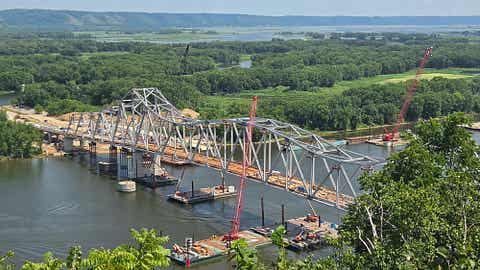
The new bridge being built across the Mississippi River at Lansing, Iowa, captures the classic look of the old Black Hawk Bridge while making marked improvements on all fronts. (Photo by Alex Burdzy)
LANSING — The demolition and rebuilding of a landmark bridge in this idyllic town along America’s greatest river has prompted convoluted detours for commuters and hurt businesses in the city’s historic Main Street district.
The Black Hawk Bridge once spanned the Mississippi River to connect Iowa and Wisconsin, acting as a lifeline for Lansing for almost a century. It became regionally iconic, featured in a pivotal scene of the 1999 David Lynch film “The Straight Story.” Now, it is being replaced with a modernized lookalike.
The bridge’s era came to an end with its closure in October 2025 and its demolition — with thousands in attendance — two months later.
Shutting down the Black Hawk Bridge cut off Lansing from a crucial river crossing. The other nearest crossings are in Marquette, Iowa (more than 27 miles south), and La Crescent, Minnesota (about 35 miles north).
Lansing Mayor Mike Verdon said residents have felt the loss of the old bridge.
“Most of the residents of Lansing are either lifelong residents, or have a family history with the town, so they’re well acquainted with the history of the old bridge,” he said. “It’s hard to say goodbye to an old friend, but everyone is anticipating the opening of the new one.”
Many older residents of Lansing lament the loss of the old bridge’s iconic design and its “singing” — a reference to the hum produced by the steel grate road surface.

“I know people that work on both sides of the river that use that bridge to commute to work,” said Clayton Burke, the Iowa Department of Transportation’s project manager for the Black Hawk Bridge. “There are people that use it to get to medical services like dental services or the clinic, and there’s the grocery store in Lansing … and people use it to get to their loved ones.”
Those hardships will continue until the new bridge is completed, expected by spring 2027.
Why the Black Hawk Bridge was demolished
DOT employees started looking into a reconstruction project in 2003, Burke said.
At the time, they considered several possibilities. The bridge could be renovated in its current state to last a couple of years more, left alone until it became functionally unusable, or demolished and rebuilt entirely.
Demolition proved to be the best option due to the litany of issues with the old bridge.
For one, according to the DOT, the old bridge was just 21 feet wide with no shoulder, and its surface was made of a steel grate instead of concrete. Its replacement will be 40 feet wide with a concrete surface and a proper shoulder.
“If you break down, you can pull over and get out of the way, or if a very wide farm implement comes through, they will have space to get through without running into other vehicles,” Burke said.
The old bridge also pushed up abruptly against the Iowa side with a tight intersection near the edge of a bluff. The new bridge significantly expands the T-intersection.
“It’ll be easier for commercial vehicles to get through and turn and safely make that passage through,” Burke said.

Additionally, the navigation channel underneath the bridge has been widened by 100 feet, making it easier for barges to negotiate the Mississippi’s main branch.
The original estimate for demolishing the old bridge and building its replacement was $140 million. The federal government was to shoulder 80%, and Iowa and Wisconsin were to split the rest. However, the La Crosse, Wisconsin, Tribune reports the cost has risen to $160 million.
Building a replacement bridge has not come without other challenges.
Naturalist Erin Cubbon at the Driftless Area Education & Visitors’ Center, an environmental museum and organization, has witnessed the decline in the town’s commerce and visitor traffic.
“We have noticed that our numbers are a little bit lower this year, but again we’re very lucky not to be affected as (much as) many of the businesses downtown,” she said.
Mayor Verdon gave this problem a more statistical framing.
“There are about 8,200 people living within a 30-mile radius of the bridge who use it regularly in both their personal and professional capacities,” he said. “It was clear from the onset that there would be a severe impact on the daily lives of each of us.”
To alleviate some of this isolation, the Iowa DOT set up a ferry service to connect Lansing to the other side of the Mississippi.
A ferry from Cassville, Wisconsin, initially served the crossing during the winter months of 2025-26. In the meantime, the contractors worked out a deal with Newt Marine Services out of Dubuque for a more permanent solution.
Newt Marine “actually built a brand-new ferry barge while Cassville was operating,” Burke said.
He applauded the team for its determination to finish an urgent project for the people of Lansing.
“They worked night shifts to get it done in time, overtime,” he said. “They put in a lot of effort and recognized that this is a critical service that we need to provide.”
The ferry can accommodate 675 to 700 vehicles per day.
When building the ferry dock, the construction firm had to consult the U.S. Army Corps of Engineers to measure the impact of construction on the floodplains along the river. Modifying these landscapes too much can lead to increased risk of flooding, a major concern in a town like Lansing, where many residents live next to the Mississippi.
“Anytime you build a structure in a floodplain, the Corps gets very interested in the size of that structure and any impact it may have on future flooding in the area,” Burke said. “We don’t want to build something that will flood somebody’s house out.”

Burke said he and his team had an easy time working with the Corps and getting their necessary permits.
“We got this permit in record time so we could start building right away,” he said.
Officials also needed to address the new bridge’s effect on a local population of endangered mussels.
“There’s protected species like the Higgins eye pearly mussel,” Burke explained. “A big part of our mitigation was hiring a service to come remove those mussels and relocate them so that we weren’t taking them or destroying those mussels.”
Higgins eye pearly mussels are native to the stretch of the Mississippi between La Crosse, Wisconsin, and Muscatine, Iowa, and are federally listed as an endangered species.
Conservation also comes in the design of the bridge. The Black Hawk Bridge was a local landmark and a symbol of the area.
“Maintaining that iconic image of the bridge for the communities in the area was very important, and it is also more cost-effective than maintaining the old bridge in perpetuity,” Burke said.
Through the old bridge’s eligibility for the Historic Preservation Act, the new bridge is being built to closely resemble the old one. One part of this preservation is using older construction techniques, Burke said.
“We don’t typically build trusses on the National Highway System anymore, but in this case, we’re able to do it to mitigate the loss of that historic structure,” he said.
Truss bridges have fallen out of favor for modern bridge construction due to changes in styles, high maintenance levels and a labor-intensive construction process, among other reasons.
More construction headaches lie ahead
The new bridge’s completion will not be the end of Lansing’s reconstruction. The town’s 1.32-mile Main Street is expected to be rehabilitated in 2028.
According to documents from the Regional Planning Commission, reconstructing the road will address concerns such as traffic safety, walkability, accessibility, environmental impacts, historic preservation, lighting and streetscape amenities.

Local Realtor Jack Sweeney was apprehensive about the timing of this second project for such a small town.
“If the DOT is going to come in and tear the street out, it’s too bad they couldn’t have done that at the same time and then the hurt would have been all at once,” he said about the bridge closure’s timing. “I feel sorry for those people down there in Lansing that are in business.”
Jackie Cooper is the executive director of Main Street Lansing, an organization whose mission is to enhance and support the historic district of Main Street.
As a result of the bridge’s closure, Main Street Lansing has stepped in to provide more community events to encourage people to stay in town. New events include the monthly “Cocktails & Connections” social and the inaugural Lansing Liberty Motorcycle Rally, which brought over 150 riders to town.
Additionally, many local businesses have hosted more events themselves, including live music and themed nights. These serve the important function of community continuity.
“While the bridge closure has presented real economic challenges, it has also highlighted just how committed Lansing is to supporting one another and adapting through difficult circumstances,” Cooper said.
This mission will become all the more important when the main avenue to get to the various businesses on Main Street will be shut off.
“Our focus will be on helping keep business owners, residents, and visitors informed with timely and accurate communication,” Cooper said. “This could include guidance on customer communication, business continuity planning, marketing strategies, signage, and ‘We’re Still Open’ campaigns to encourage people to continue shopping and dining downtown during construction.”
“Ultimately, we see this as an investment in Lansing’s future,” she said. “While construction will undoubtedly bring challenges, it’s also an opportunity to create a stronger, more vibrant downtown that will serve our businesses, residents and visitors for generations to come.”
A live webcam of the bridge construction is available here.