

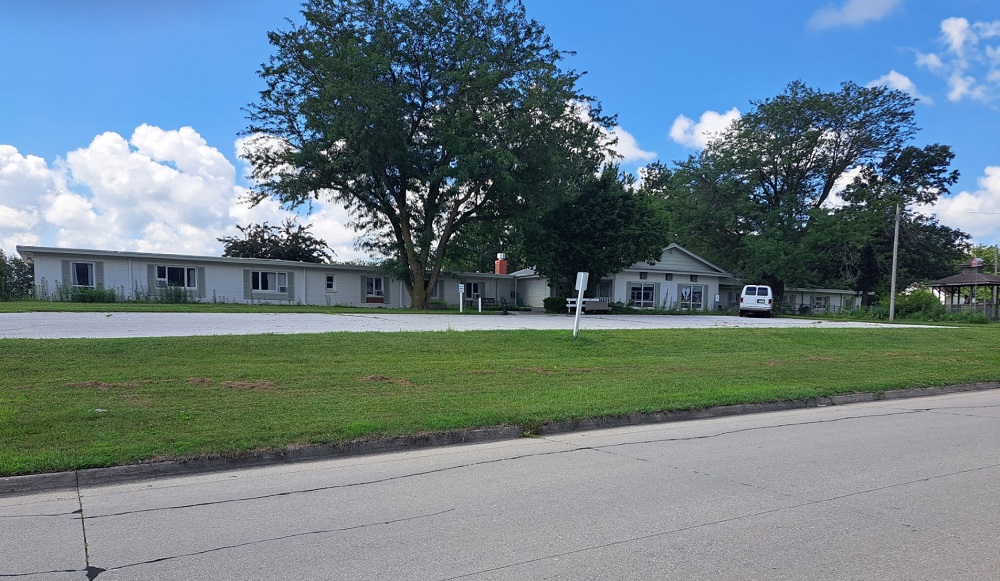
When Alice Derry, secretary of the Perry Lutheran Home, picked up my bicycle and me in Vinton and drove me to Perry on Jan. 23, 1995, to become the administrator of the Perry Lutheran Home, the property at 2625 Iowa St. was known as the Perry Manor. Later the names changed, and it became Perry Healthcare Center, Pearl Valley Nursing and Rehab and most finally Aspire of Perry. The facility closed earlier this month.
The Dallas County Assessor’s website says the building was built in 1965. This occurred after the opening of the Perry Lutheran Home in 1956 and the Rowley Memorial Masonic Home in 1957. For Perry this became the modern era for nursing home care.
Many years ago, I had heard older people in Perry talk about a large house in Perry that took in older people who had no one else to care for them. In other words, a boarding house. I do not know how well this boarding house cared for their tenants or what the conditions were like. I suppose that they did the best with what they had to work with and what they knew.
Even with the start of the modern era, what was considered state-of-the-art care methods in the 1950s, 1960s, 1970s and even the 1980s can nowadays be considered barbaric. It is likely that in 30 years, what is considered to be great care now will be viewed as awful by then.
A few care methods from the past include the restraining of residents so they could not get up to walk and then fall, either out of a chair or bed. At one time, something called “reality orientation” was used. It was thought that the best thing to do for people with dementia was to tell them that what they perceive is not real and try to make them realize it. It does not work.
Many years ago it was also thought to be a good idea to force feed people who would not eat or to thin down to a liquid state the food of people who had a hard time chewing and swallowing. It causes them to aspirate.
Throughout my early time in Perry, my impression of the Perry Manor and Perry Healthcare Center was that it was the least desirable of the three long-term care facilities in town. It was privately owned, and you never heard much about it. There was never much interaction with it in the community. The administrators seemed to change quite often.
One time in the middle 1990s at the Perry Lutheran Home, we invited the administrator of the Perry Healthcare Center over for lunch. She was very nice and as I recall quite young. Later another of its administrators served for a period of time on the Pegasus Cable Channel 12 Board. Her name was Ardell Erickson. She was a great person, and I believe that she moved out of town or state.
I never thought that I would ever have much to do with the Perry Manor/Perry Healthcare Center except to drive by it and visit it as part of a Perry Area Chamber of Commerce event.
This all changed in 2016. I was in need of employment, and the Perry Healthcare Center had an opening for an administrator. I know that I started the Thursday before Memorial Day, which would have been May 26, 2016. The owner was excited that I had agreed to take the position. I was happy because I was getting paid more than I had ever been paid in my life, but I was also nervous about what expectations could be with a for-profit facility.
I had worked previously only in the nonprofit long-term care world, which viewed the private long-term care world as the Dark Force of the nursing home industry.
In all reality, nonprofits must make a profit too. Otherwise, they would not have enough resources to make improvements. The perceived difference is that in the nonprofit world monies go back into the operations, while in the private world profits go into the pockets of the evil, greedy, non-caring owners. Let me tell you that there are also evil, greedy, non-caring people in the nonprofit world.
My first day started with meeting with the then current Administrator Dan Hanson, a wonderful person who was moving on to another facility the next week within the company. My main job then was to learn about the time-clock operation within the two days that I had with Dan. Any time I see him, he calls me Mr. Doug.
I then had the pleasure of interacting with the department heads, all of whom are wonderful people and still friends of mine today. Stacey West from Harcourt was the director of nursing. Mary Means was the activity/social services director and her husband, John, who frequently volunteered with her ideas for activities.
Greg McLeod, a retired U.S. Navy veteran, had a rather unusual position. He was the maintenance and housekeeping/laundry director. The twist was that he was also the dietary director. This was unusual, but in such a small facility it worked, and he did a great job in all four of these roles. His wife Judy also worked in the laundry. With such a small facility, communication was not a problem. Everything that was done involved all the other departments.
There was also the owner, Bruce Mehlhop, and the staff at the corporate office in Johnston, Brenda Fiori and Deb Richardson. Bruce is a great person, and Brenda and Deb were geniuses with their positions and had a good sense of humor. There was the corporate nurse, Kevin Utterback. I had the pleasure of working with him again in Polk City, when he assumed the MDS/care plan position. The man is a genius in this area. All these people are still friends of mine today. The same can be said for many of the other staff and volunteers too numerous to name.
Dr. Eric Ash was the medical director, and he genuinely cared about the welfare of the residents.
As I said, I was nervous about how the care would be for the residents and the staffing quality. The population of residents there was entirely different from what I had experienced in my previous 34 years in the industry. There were your typical older residents who needed assistance, but I had never seen so many younger people and men in a long-term care facility. There were a lot of residents who suffered from mental problems and could not care for themselves. Some of them had come from the streets of Des Moines. They were generally a lot younger than what I had experienced before. Many of them were in their 50s or 60s.
Some of them were older but with a lifetime of mental problems. In many cases their parents had passed away or were in bad health and could not help them any longer. Other relatives did not want to have anything to do with them, which is understandable, because they could be very difficult to deal with. You saw a lot of schizophrenia and bi-polar disorder. Last summer when I was riding the shuttle bus to the Iowa State Fair, I saw several of the same type of people living on the streets of downtown Des Moines. All of them who I saw were men.
These were people that other facilities would not take. These residents generally did well in the facility, if they were taking their medications. Several of them did have minor behavior challenges.
My fears of staffing quality soon subsided. Most of the staff were excellent and really cared about the residents. It was the same with the volunteers. As in the nonprofit world, you had some not-so-desirable staff, and there were never enough staff, particularly in nursing. Plus in the long-term care world people job hop quite a bit.
I have to say that my fears of how the corporate people would provide for the residents quickly ended. The corporate people did ensure that the residents received the services and equipment that they needed. It was not fancy but met the residents’ needs. The food menus were basic but always of good quality. I ate at work and enjoyed it every day. Mary and the volunteers strove to provide activities that the residents enjoyed. The residents had a good quality of life, and for many it was very comfortable compared to what they had been through in their previous lives.
The biggest issue that we had was care of the building and replacement of equipment. When 99% of your residents are on Medicaid, money to cover things gets tight. Each year you hear on the news how much the state of Iowa is paying for Medicaid. It is a lot of money, but if the state is giving you a daily rate that is $50 or more per day lower than your daily costs, over time you slowly get further behind and are going to need to close. The private pay residents then must make this up for you, and we did not have enough of them to accomplish this.
At the start of 2017, the company had been bought by a group out of New Jersey and the name changed to Pearl Valley. They were very devout followers of the Jewish faith. Their personnel came to Iowa each week, but they had to be home by Friday evening. Like the company before, they cared about the residents and provided them with what they needed. They faced the same issues with the Medicaid rate in terms of finances.
Some of their facilities in the rural areas of the state suffered greatly from staffing challenges. Despite my Pollyanna memoir, let us not forget that we did face challenges. People are people, and sometimes there are disagreements among staff. Also, in every place that I have worked, you have staff and residents who like to stir things up for no reason. At times we faced staffing shortages. At other times some of the residents could give you challenges with less-than-desirable behaviors. Sometimes resident families and responsible parties were difficult.
What is sad about the closing of Aspire of Perry is the question of where will the type of residents that they specialized in go. What about the future of people like them? Many of these residents came to the long-term care facilities because the mental health care facilities were closed by the state to save money.
Over the course of the past few years, we have seen many small rural facilities in Iowa close that catered to the same types of residents that Aspire did. What will happen to these people? In my experiences, our politicians are not concerned about these residents. It costs money to care for them, and there is no political advantage in championing them.
This marks the closing of the fourth former facility that I have been employed with. Like a lot of things, after 44 years situations change and time moves on. What does the future hold for the other three facilities that I have worked for that are still open? I guess that time will tell.
Farewell Perry Manor, Perry Healthcare Center, Pearl Valley Nursing and Rehab and Aspire of Perry. It was an eye-opening experience for me. God directs you to places you never think that you will go. Thank you, Lord, for the experiences with Perry Healthcare Center/Pearl Valley Nursing and Rehab and the many great people that I got to meet. Thank you for allowing me to help to care for those residents in need.
There is a lot of land adjoining the facility. I am sure soon that the structure will be torn down and a new business will arise there. Maybe it can be the location for Iowa’s first Waffle House. Better yet, it would make a great location for a data center. I know that the Perry’s City Fathers are facing a budget challenge. A data center could help alleviate this issue and replenish the coffers.
Also, for whoever ends up with the building, you might find a very old church pulpit on the west end of the facility, which housed the community room. I believe that it came from one of the former African American churches in Perry that had closed. The late Homer Perkins told me that this church was on Eighth Street south of the Perkins home, which was located at 1721 North St. in Perry.
Homer bought the land and church building after it closed. Homer said that the foundation was caving in, and there were contents still in the church when he bought it. He gave away some of the pews that were used at the Pattee Park baseball field dugout until they deteriorated. I speculate that this pulpit came from the same place, since his parents had resided at the Perry Manor. If you do not want the pulpit, please give me a call.