
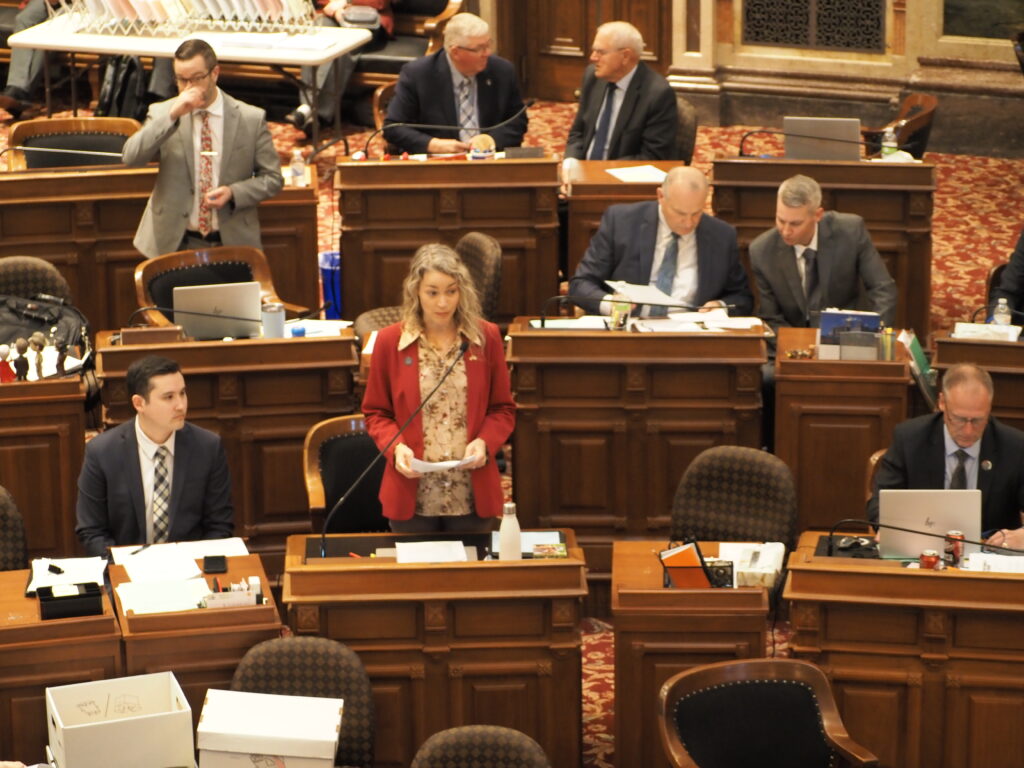

Sen. Kara Warme, R-Ames, shared details on an updated proposal making changes to the state Early Childhood Iowa system during floor debate May 1, 2026. (Photo by Robin Opsahl/Iowa Capital Dispatch)
After five subcommittee meetings and multiple iterations, legislation making changes to the Early Childhood Iowa system passed the Iowa Senate Friday.
Senate File 2488, as passed by the Senate in a 28-15 vote Friday, looks significantly different from initial language brought before lawmakers early in the 2026 session. In its earliest phases, the bill proposed creating a statewide Early Childhood and Family Services (ECFS) system of seven “health and human services districts” and repealing the existing Early Childhood Iowa (ECI) program, with ECI funding and oversight duties transferred to the new system.
This proposal was met with heavy opposition from Iowans serving on ECI boards and advocates. In following meetings, officials with the Iowa Department of Health and Human Services shared an updated proposal that would keep the existing system of 34 ECI area boards as is, but transfer funding oversight to the state for money currently managed through the ECI system for home visitations, family support services and parent education programs through the “School Ready Fund.”
GET THE MORNING HEADLINES.
HHS officials said this shift in funding was needed because it would allow the state to draw down federal funding made available through the Family First Act, which requires that funding goes toward “evidence-based” home visitation models. But advocates for ECI said this funding shift for home visitation services — which represented roughly half of the $28 million appropriated through the ECI system — would effectively remove local ECI boards’ abilities to fund services that best suit their community needs.
The amendment presented by Sen. Kara Warme, R-Ames, to the Senate Friday further scales back the shifts made to the ECI system. The latest proposal creates an opt-in, voluntary system for ECI area boards to choose to move their home visiting contracts over to the state level, which would allow HHS to draw down federal funds. By choosing to move these contracts to state oversight, the participating ECI areas would have a portion of the federal matching funds returned to their area — beginning with 25% of funds in fiscal year 2028, and reducing by 10% each subsequent year.
Warme said the hope is for several ECI areas to choose to participate in this system so the state can “create a pilot program, so we can prove out the best way to administer these contracts and to maximize our funding opportunities for Iowa.” The measure additionally calls for an interim legislative study committee to examine the existing ECI system and recommend changes to lawmakers ahead of the 2027 legislative session on “how to map those 35 four ECI areas into our seven HHS districts, and again, how to optimize services for early childhood within our state,” Warme said.
Rep. Cindy Winckler, D-Davenport, said she appreciated the changes made in the amendment, though she said this may not result in many home visitation service contracts being transferred to HHS oversight.
She questioned how successful the voluntary shift of home visitation funding from ECI to HHS would be, “… because, in many cases with the language, they lose contracting with those local providers. It would be a decision that ECI would be making rather than the locals, in regard to the home visitation programs, and I think that the value of ECI is still local control.”
She also brought up concerns about changes remaining in the amended legislation to the state boards for Decategorization Projects, or Decat, that directs state child welfare and juvenile justice funding to local services. Winckler said while the measure was changed to create an opt-in, voluntary system for shifting funding to HHS for ECI boards, the shift in funding from Decat boards to HHS will not be voluntary. The bill still also creates the larger Early Childhood and Family Services (ECFS) system structure, but does not eliminate other bodies like ECI.
“In many cases — Decat, all of it going to Health and Human Services — creates very interesting dynamics in the counties or in the ECI area boards, because many of the Decat directors are also ECI directors,” Winckler said. “And so I’m not quite sure what the balance is in regard to that. But it is great that compromises have been made.”
Warme said the changes being proposed in the bill are meant to better provide services for young children throughout the state who receive services through a variety of bodies, including ECI and Decat boards, as well as the state’s child abuse prevention program, by moving to a “modernized structure, where we can spend less dollars on administration, on maintaining a separate structure, and do more to prevent, and connect services across our state.”
“I think we all can recognize that change is hard,” Warme said. “When we look to restructure systems that have been in place for a long time, there’s a lot of stakeholders, there’s a lot of concerns. … So the point of a new Early Childhood and Family Services system is to reduce administrative costs and maximize funding, to eliminate redundancies and inconsistencies, to ensure consistent oversight and management — as we’ve seen public dollars used, not in those ways, in neighboring states.”
The measure moves to the House for further consideration. In the House, lawmakers had passed House File 2795 — a bill that did not include the changes to ECI or other system, but called for a study committee to be convened within HHS over the 2026 interim to study the impacts of the proposed change to the ECI system and home visitation services.
Rep. Michael Bergan, R-Dorchester, called his proposal a “bookend” — a version of the legislation on the opposite end from proposals brought forward by HHS earlier in 2026, with aims of finding a compromise in the middle. The amendment conforming with the Senate language was filed to the House bill Friday.
YOU MAKE OUR WORK POSSIBLE.