

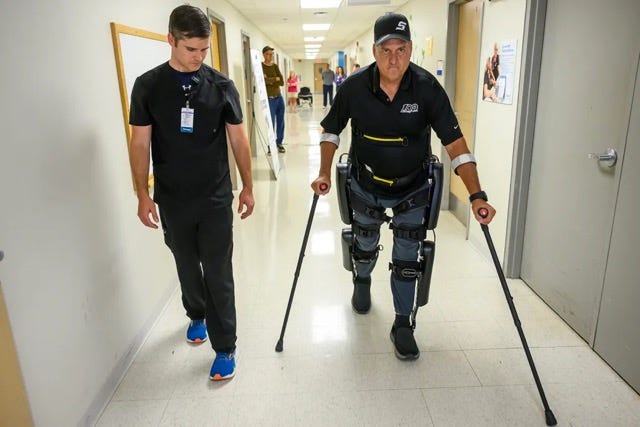
Doug Boswell trying out the ReWalk Exoskeleton to take his first steps after his T-11 spinal cord injury. (Photo by David Middleton/MU Extension Courtesy Appointment, Missouri AgrAbility Level 2 Assessor)
 Doug Boswell is no stranger to challenges. He grew up on a southern Oklahoma farm, helping his dad raise beef cattle, and grow forage crops. He left the farm after high school graduation, but the dream of farming again never left him.
A few years after his parents moved to Missouri, he followed so he could help them out. He and his wife, Teresa, met while working at Snap-On Tools in Springfield. But they wanted a rural acreage where they could raise cattle and hay, and hunt. In 2014, the year he turned 52, they discovered 160 acres near Stockton.
“It had 80 acres of heavily wooded, and 80 open acres for cattle – it was perfect,” he says. “The plan was retiring from my job at 55 and farming full time.”
The Boswells continued their day jobs, and spent weekends mowing their property, repairing fence, and building a hay barn. They made plans for a new home there, and within a few years, their Gelbvieh herd had grown to 65 head.
Then on a cold November day in 2017, after they finished feeding cattle, Teresa headed back to the pickup to warm up a bit. One cow took off on a dead run through an open gate. Doug knew the fences wouldn’t hold her, so he jumped on the ATV. When the cow abruptly stopped directly in his path, he braked, and the ATV flipped.
He doesn’t recall much more. He didn’t have his phone, and it was 45 minutes before Teresa discovered him. He had broken all the ribs on his left side, along with two on his right side, shattered his right shoulder, and punctured a lung.
But worst of all, he couldn’t move his legs. He was transported 60 miles by helicopter to the hospital in Springfield, where they confirmed his spine was fractured. The neurologist told Doug he’d be paralyzed for life.
He had two surgeries. After consulting neurosurgeons at Madonna Rehabilitation Hospitals in Lincoln, Nebraska; Frazier Rehab Institute in Louisville, Kentucky; Shirley Ryan AbilityLab in Chicago, and Craig Hospital in Englewood, Colorado, his prognosis remained the same: T-11 spinal cord injury. But he was more determined than ever to walk again.
Help closer to home
During two-and-a-half months of intensive physical therapy at Craig Hospital, his desire to farm never dimmed. His doctors told him about the National AgrAbility Project, and its outreach to disabled individuals through assistive technology. After returning home, he followed up with Karen Funkenbusch, Missouri AgrAbility Project director and a University of Missouri Extension professor. She visited him at the farm in March 2018 with her team, including an agricultural engineer and case managers from the Missouri Department of Elementary and Secondary Education (Mo-DESE) Vocational Rehabilitation.
They advised him how to adapt his pickup and tractors with hand controls and apply for an extension hoist-and-chair to lift him into his pickup bed, enabling him to attach implements. He also qualified for a track chair, a motorized wheelchair with treads to navigate the farm’s uneven terrain.
“As a patient, Doug became a strong advocate for what he needed,” Karen said.
He celebrated his successes when he could brush hog again, cut hay, and change oil in his tractors.
In the spring, Doug began using a bud box corral to vaccinate his cattle. Cows are guided into it through an alley chute, and he pulls a lever to keep them stationary. He also installed gate openers.
He and Teresa modified the plan for their 3,200-square-foot house. It would be an accessible one story with ramps and wide doorways, and an exercise room for maintaining his upper-body strength. “I use a stand-up frame to keep my bones strong,” Doug says. They moved in by October 2020.
None of these retrofits and workarounds convinced anyone that Doug was resigned to his lack of mobility. “He refused to be a sit-down farmer,” Karen said. “His goal was to walk again.”
New world of wearable exoskeletons
Seven years ago, when Karen Funkenbusch and her team conducted two on-farm assessments, they agreed Doug’s best option was a standing wheelchair. It was fully funded, along with other devices, by Missouri Vocational Rehabilitation.
He spent five winters at Brooks Rehabilitation, a neuro recovery center in Jacksonville, Florida, where he participated in clinical trials, using robotic-assisted walking devices and body-weight-supported treadmills. In 2019, for the first time since going there, his knee-jerk reflex test demonstrated an ability to move his feet. It was a game-changer.
The stage was set for him to pursue his goal of walking. Beginning in 2015, veterans had been eligible for FDA-approved wearable robotic exoskeletons. Worn over clothing, an exoskeleton is composed of an external, powered, motorized frame that fits to the limbs and body. Powered by a battery waist pack, it enables individuals with spinal cord injuries or stroke damage to stand and walk and sometimes climb stairs.

The out-of-pocket purchase of a robotic exoskeleton, at approximately $100,000, was out of reach for most until it was approved by Medicare in January 2024.
Although AgrAbility closed his case in 2018, Doug and Karen had continued their conversations about how he could take the next steps to walk again.
He filled out forms for the Indego Exo Personal and ReWalk Exoskeleton, and tried out both units.
Next, Doug was required to see his doctor, where he passed a DXA Scan for bone density, and was checked for pressure sores, small fractures in his spine, height and weight criteria, and his level of spinal cord injury.
ReWalk set up a Zoom meeting. “They wanted to see if I could complete weight transfers in and out of my chair on my own. They needed to see how flexible I was,” he said. The next step was meeting a ReWalk team at Mercy in Springfield where he would spend two hours wearing a custom-fit exoskeleton weighing 60 pounds.
With the push of a button, a wrist-worn communicator powered him from a sitting to standing position. Forearm crutches assisted with his balance.
“I just got in it and started walking,” he said. “Everything was great. It was that quick to try it out.”
After 37 supervised sessions, Doug had learned how to get up if he fell, how to go up and down stairs, and navigate curbs. He was allowed to take the exoskeleton home in February 2024, where he walked 100,000 steps on the patio and in the house.
Medicare paid for 75% of Doug’s ReWalk and his secondary insurance paid 25%.
The good and the not good enough of exoskeletons
Although his dad, Roy, and his brother-in-law Bob Arrington often help him with farm tasks, Doug was ready to be more independent. “I wanted to work on my vehicle and tractors in my shop, and carry tools back and forth,” he said.

But it’s still a work in progress. “My hands and arms aren’t free using the crutches,” he said. “I had to adapt my pickup to open up the driver’s side to get out easily.”
During haying season, Doug says it saves time to use his track chair. “It takes five minutes to get out of the ReWalk, and seven minutes to get into it,” he points out. “You can’t bend easily, or get on your knees, so it’s not feasible for some work – it isn’t quite there yet.”
His goal is walking 2,500 steps in the exoskeleton daily. “In snow and ice, or on wet tile floors, you’re not going to do it –you’ll just tip,” he says. “You’re strapped in completely, locked in. It’s a learning curve, there’s a lot of balance involved.”
On the home front, he says, “I’ve tried brushing my teeth, bending down to rinse my mouth, but I have to undo two straps, and can’t straighten back up without those fastened.”
But he can shop for groceries, pushing the cart, sit in the church pew, and get daily exercise. He’s currently working with a University of Arizona study team to tailor an exoskeleton more to the ag sector.
ReWalk batteries cost $2,500 each, and he keeps them plugged into a smart charger. “It’s worked perfectly,” he says.
ReWalk offers a 5-year warranty. “I’ve been using the heck out of it,” he says. “ReWalk gets back to me in two to five days.”
Technology advances daily
Karen Funkenbusch continues to monitor assistive technology breakthroughs for Missouri AgrAbility clients, and keeps in touch with Doug.
“Doug was not going to not walk,” she says. “When I met him, walking was his lifelong dream. We’ve gone through lots of emotions these past few years. Doug’s been willing to participate in various clinical trials to get where he is today, and AgrAbility has been a key partner.”

She adds, “Technology is changing by the moment. AgrAbility’s challenge is how to provide guidance, support, and direction to Doug and other farmers as they continue to move down this path.”
Doug’s goal this winter is wearing his ReWalk to repair a tractor with a burned out top motor. “Mechanics use roll carts all the time,” he says. “I may need help for some work if it takes two hands.”
He adds, “I’m still learning what I can do.”
Editor’s note: Please consider subscribing to the collaborative and its member writers to support their work.