
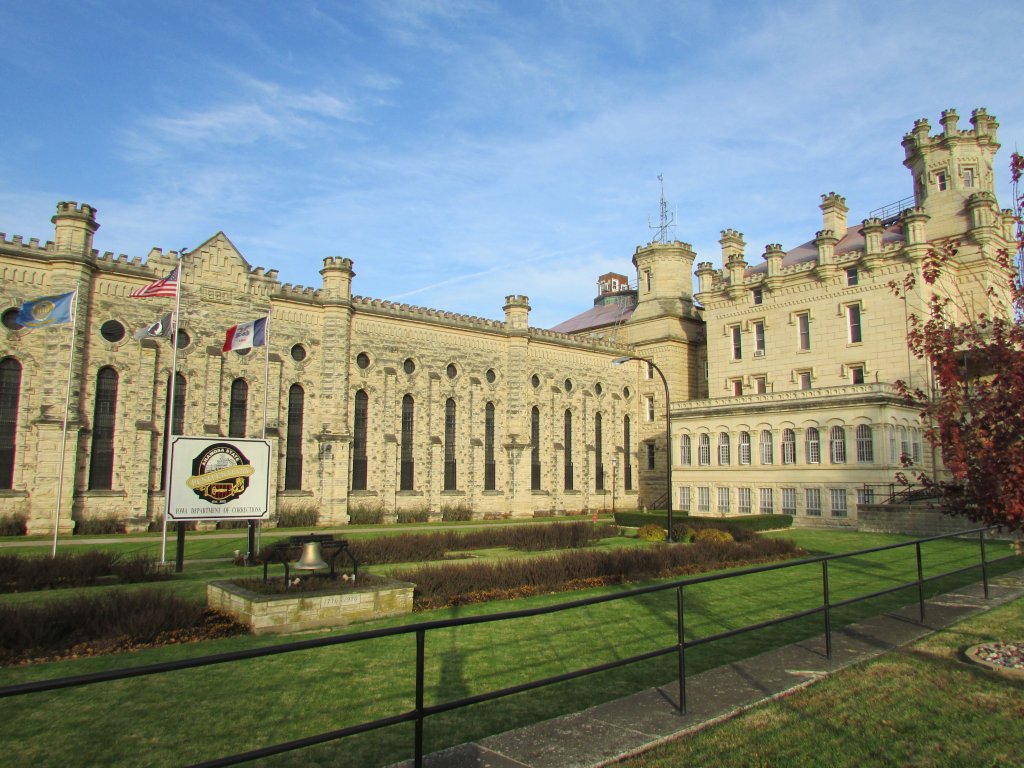

Exterior of Anamosa State Penitentiary, a maximum-security prison where one wing has air conditioning in cells and one does not. (Photo courtesy of Iowa Department of Corrections)
As summer temperatures rise into the 90s, more than 1,000 Iowa prisoners and correctional officers are sweating it out without air conditioning.
Prolonged heat waves behind bars can cause heat stroke and exacerbate chronic conditions like asthma, heart ailments and arthritis. Studies also show prisons without air conditioning are more violent.
For years, the Iowa Department of Corrections has been asking lawmakers for funding to install air conditioning at the Anamosa State Penitentiary and the Mount Pleasant Correctional Facility – prisons that regularly house more than 1,000 men each.
The Iowa Legislature adjourned in May without approving the $8.1 million for the projects.
But something is different this year.
The Corrections Department has been selling farmland around state prisons and has nearly $8 million left after other repairs and renovations. Agency leaders won’t say whether they intend to spend the windfall on air conditioning, but advisers think they should.

“I think the most important thing is to make sure the staff and inmates’ health is the priority with the air conditioning,” said Trent Keller, of Waterloo, chair of the Iowa Board of Corrections. “I wouldn’t want to be in a place that is 80 to 90 degrees and all I’ve got is a small box fan to cool me down.”
Hot and bothered
Stifling cells, condensation puddles, poor sleep, trouble breathing – these are complaints from men who have been incarcerated at Anamosa and Mount Pleasant during periods like this week, when heat indices are over 100 degrees.
“It’s been a persistent complaint we’ve gotten for years,” said Bert Dalmer, senior deputy ombudsman for the Iowa Office of Ombudsman.
In 2025 alone, the office fielded six complaints – four from prisoners at Anamosa and two from Mount Pleasant – about lack of air conditioning. Mount Pleasant, with more than 1,000 prisoners June 30, does not have AC in most housing units. In Anamosa, one wing has air conditioning, but the bulk of the 1,200 prisoners there do not.
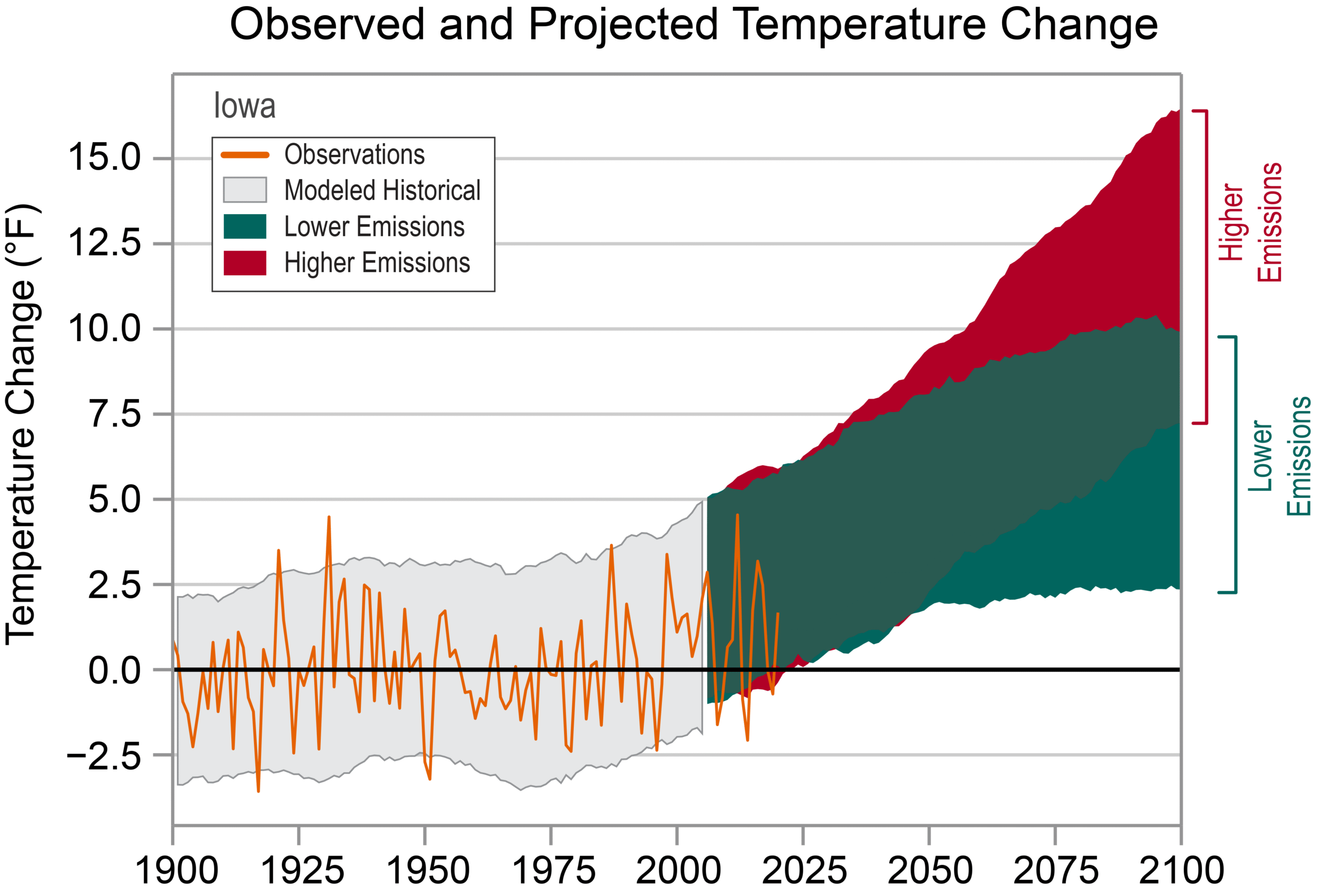
Climate change is causing more extreme weather in Iowa, including more heat waves. While Iowa’s average summer daytime high temperatures haven’t changed much in recent decades, nighttime temperatures are hotter, likely linked to humidity, the National Oceanic and Atmospheric Administration reported.
Heat stress increases prison dangers
Heat stress contributed to the 2024 death of a man held at an Illinois prison without air conditioning. When a prison nurse found Michael Broadway, 51, unresponsive at the Stateville Correctional Center June 19, 2024, she called 911, WTTW News reported. The dispatcher mistakenly thought Broadway had been outside.
“No, he’s been in his cell, but it’s like 100 and something degrees in here,” the nurse said in the call recording obtained by the TV station.
The Stateville prison was closed in 2025.
Correctional officers not only have to endure the heat themselves, but they may face risks of increased assaults or other violence among offenders.
In a study published in 2021, researchers found days with average temperatures of 80 degrees raised violent interactions among Mississippi inmates by 20%. To reach an 80-degree daily average, the daytime temperature often is over 90 degrees and nighttime temperature above 70 degrees.
“There are people who say ‘Those inmates are in prison. They don’t deserve to have AC’,” said Todd Copley, president of the American Federation of State, County and Municipal Employees Council 61, which represents Iowa correctional officers. “But walk a mile in their shoes and see how you feel. Their attitudes, their demeanor affects how the day in the life of a correctional officer goes.”
Fifteen years of requests denied
The Anamosa State Penitentiary was built in phases from 1875 to 1899 from limestone quarried at the nearby Stone City. The first offenders came to the prison well before Willis Carrier invented the first electrical air conditioning unit in 1902.
Even today, only a handful of states have air conditioning for all incarcerated individuals, USA Today reported.
The Iowa Department of Corrections has been asking lawmakers to fund air conditioning upgrades in the prisons for at least 15 years, according to a 2020 story in the Iowa Capital Dispatch.
Gov. Kim Reynolds echoed the need this year by including $8.1 million in her budget for prison AC projects. The money would have come from the Rebuild Iowa Infrastructure Fund (RIIF).
Lawmakers again did not approve the projects.
Rep. Jacob Bossman, a Sioux City Republican who chairs the RIIF budget subcommittee, said his party has invested in prison projects that improve public safety and capacity.
“So long as Iowa House Republicans remain in the majority, the comfort of convicted criminals will never take priority over the safety of law-abiding Iowans,” he said in a statement. “While funds to add AC are worth evaluating, funding decisions are ultimately about prioritizing the most urgent public safety and infrastructure needs.”
Farmland sales provide funds
State appropriations supply the vast majority of Iowa’s prison funding. But in 2023, a consultant suggested another source of one-time money. The Guidehouse Government Alignment Project recommended the Corrections Department and other state agencies sell farmland around their facilities.

For more than a century, prison farms in Iowa and other states supplied food for incarcerated people and taught inmates how to work the land.
But as the average Iowa farm has ballooned in size and farm work has become more automated, prison labor is no longer used.
So far, the Corrections Department has sold more than half of the 3,446 total farmland acres for about $18 million. Another 1,300 acres near Anamosa is expected to bring in another $10 million, the agency reported.
The Corrections Department has spent $10.3 million so far on the following:
- $7.4 million to complete a kitchen and laundry project at Clarinda Correctional Facility
- $2.9 million to build or renovate offices for 4th Judicial District and 5th Judicial District corrections staff
That leaves $7.7 million.
When the Iowa Capital Dispatch asked Corrections Department officials whether that money could be spent on air conditioning, they replied in a June 3 email: “Infrastructure needs are determined and approved by Director (Beth) Skinner and Steve Dick, DOC Financial Manager, based on most imminent needs of the Department.”
A new wrinkle in the prison funding picture is House File 2542, which requires some three-time felony offenders to spend at least seven years in prison. The “three strikes” bill is expected to increase Iowa’s prison population by 50% and require building three more prisons and expanding others at a total cost of $1.9 billion, the Legislative Services Agency reported.
Larry Smith, a board member with Iowa Citizens for the Rehabilitation of Errants (CURE), speaks frequently at Board of Corrections meetings about air conditioning needs. He fears HF 2542 will push the cooling projects back down the priorities list, leaving inmates to continue to suffer sweltering conditions.
“Common sense tells me they are going to use it for new prisons rather than upgrading old prisons,” he said.